The Notebooks, 1981–82
Every page of the Apple II notebook, unretouched, so you can check the essay against the record.
The essay shows selected pages and close crops, which is the right way to tell a story and the wrong way to check one. This page has the whole notebook as it survives. Read it in full and judge the parallels for yourself.
- What
- Loose-leaf ruled pages in ballpoint and pencil: design notes, maps, program plans and Applesoft BASIC for a text adventure.
- Where and when
- Rosemère, Quebec, 1981–82. How the pages are dated.
- Photographed
- In one sitting on July 23, 2026. Rotated and resized only. No retouching, no contrast changes, nothing removed.
- Order
- As photographed. Three pages that were photographed twice appear once. One later page is marked.
- Originals
- Held by Daniel Riley. Full-resolution files on request for research or archival review.
- Use
- © 2026 Daniel Riley. Free to view, link and quote for research and review, with credit. Ask about anything else.
The notebook
20 pages. 14 of them are discussed in the essay; the rest are here so nothing is hidden. Tap a page to enlarge it, or open it full size.
 p. 01
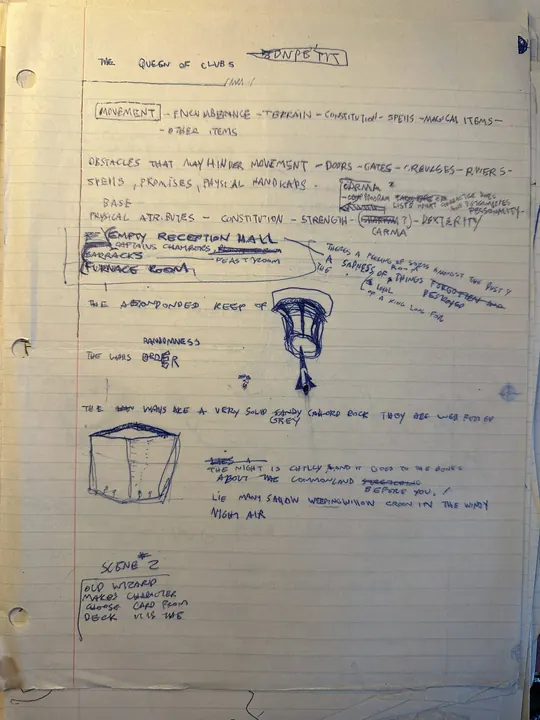
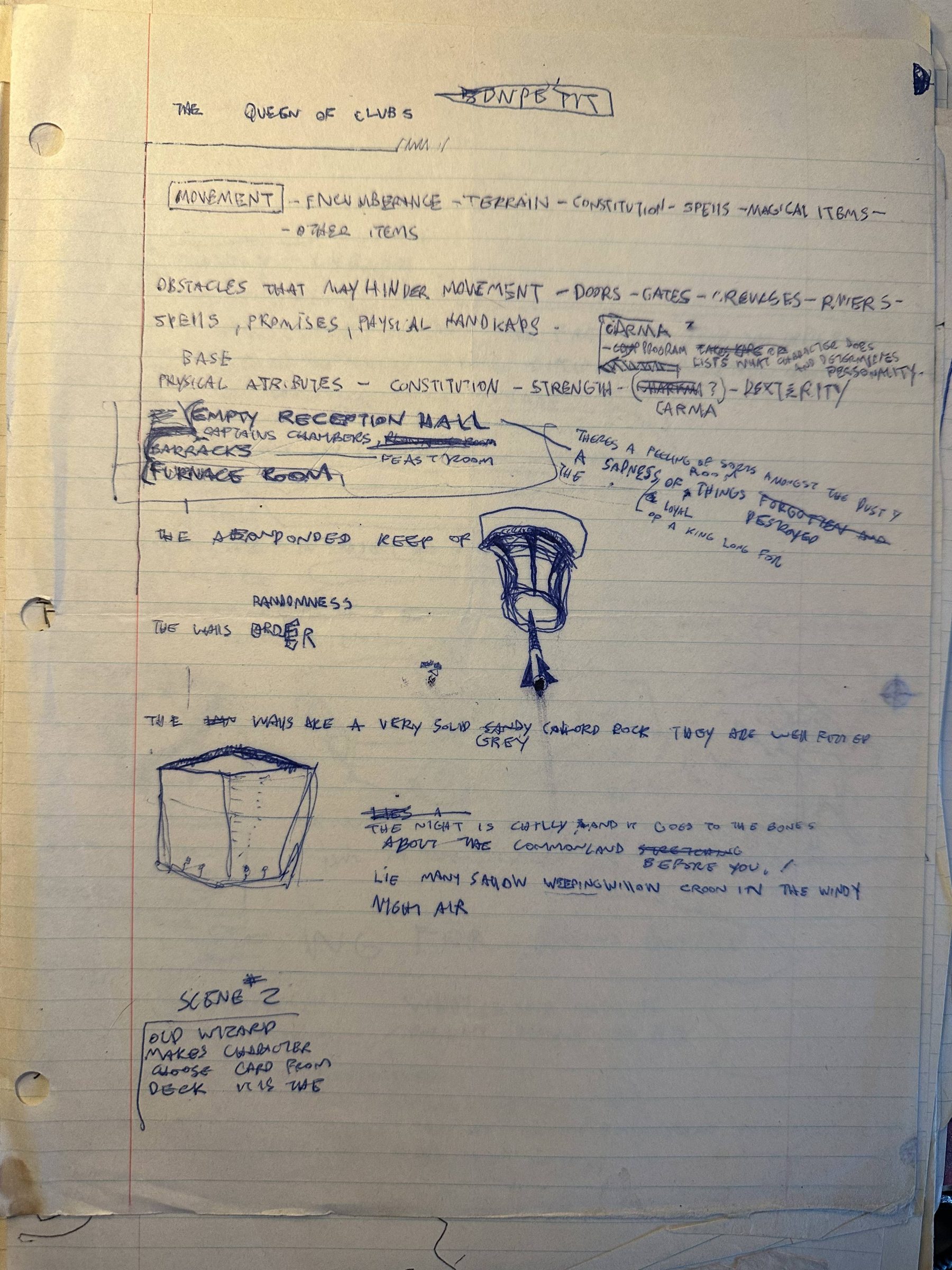
The Queen of Clubs
Game rules in outline: movement, encumbrance and terrain; obstacles such as doors, gates, crevasses and spells; base attributes (constitution, strength, dexterity); the rooms of an abandoned keep. “Scene 2: old wizard makes character choose card from deck.”
 p. 02
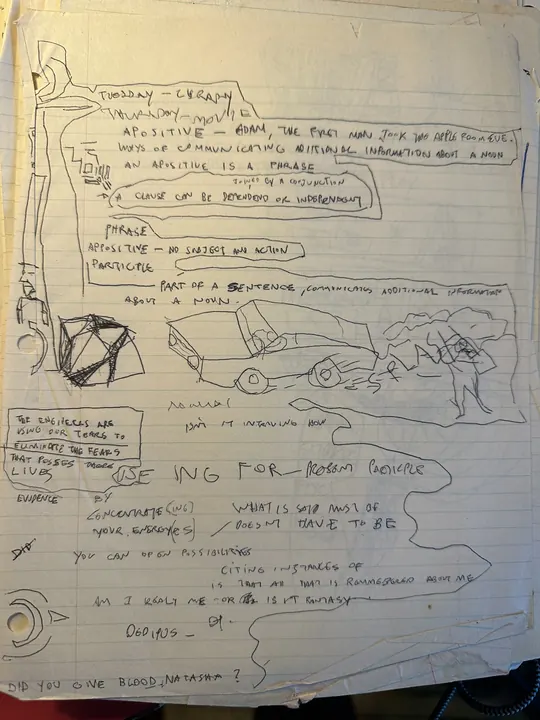
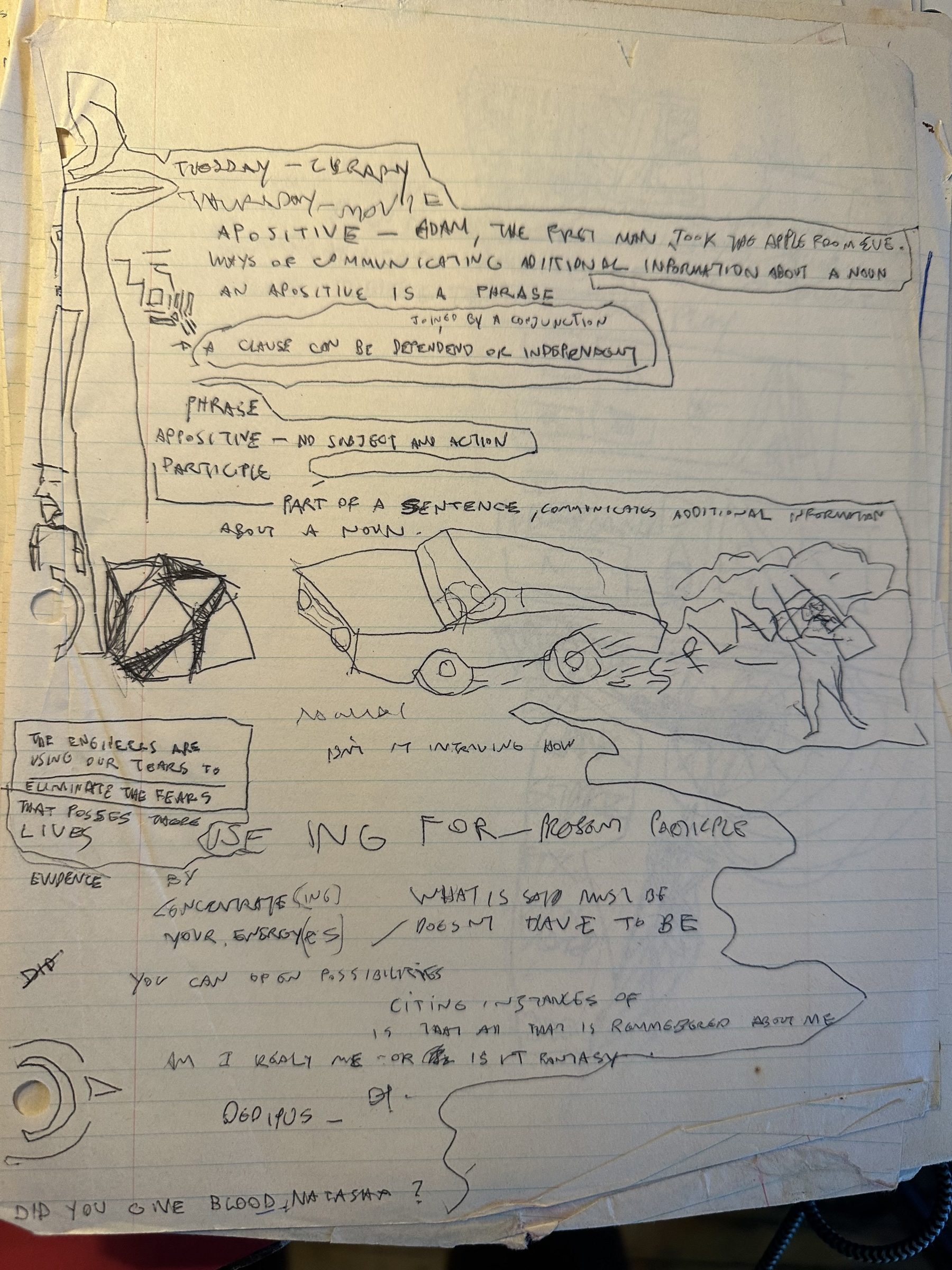
Grammar notes
Class notes on appositives, phrases, clauses and participles, with sketches. The notebook doubled as a school notebook.
 p. 03
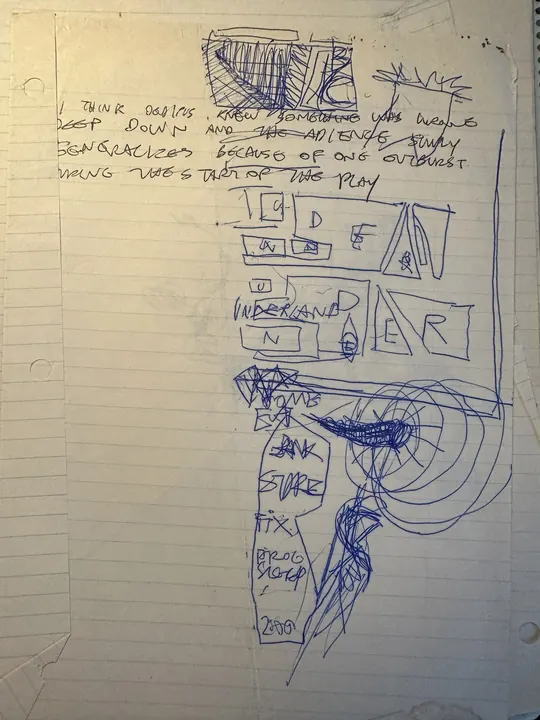
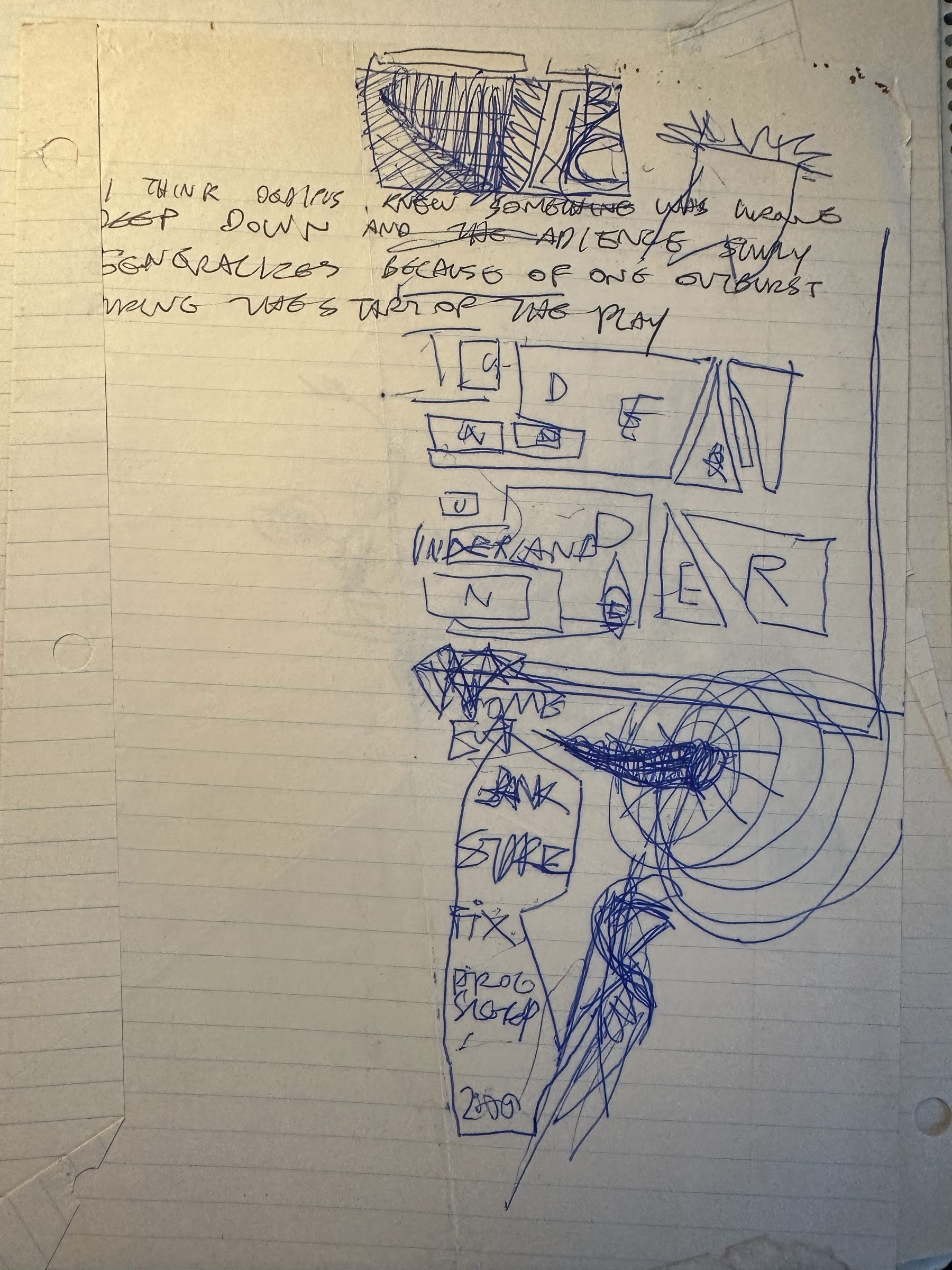
A map sketch
A map of streets and buildings, beside an English-class note on Oedipus.
 p. 04
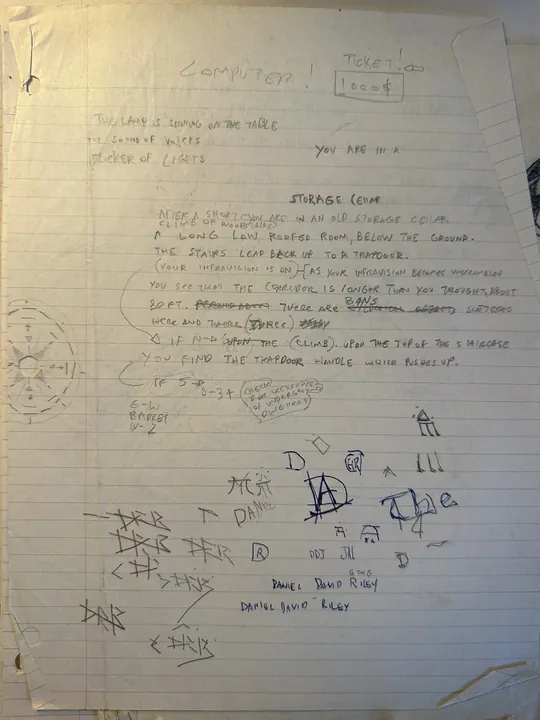
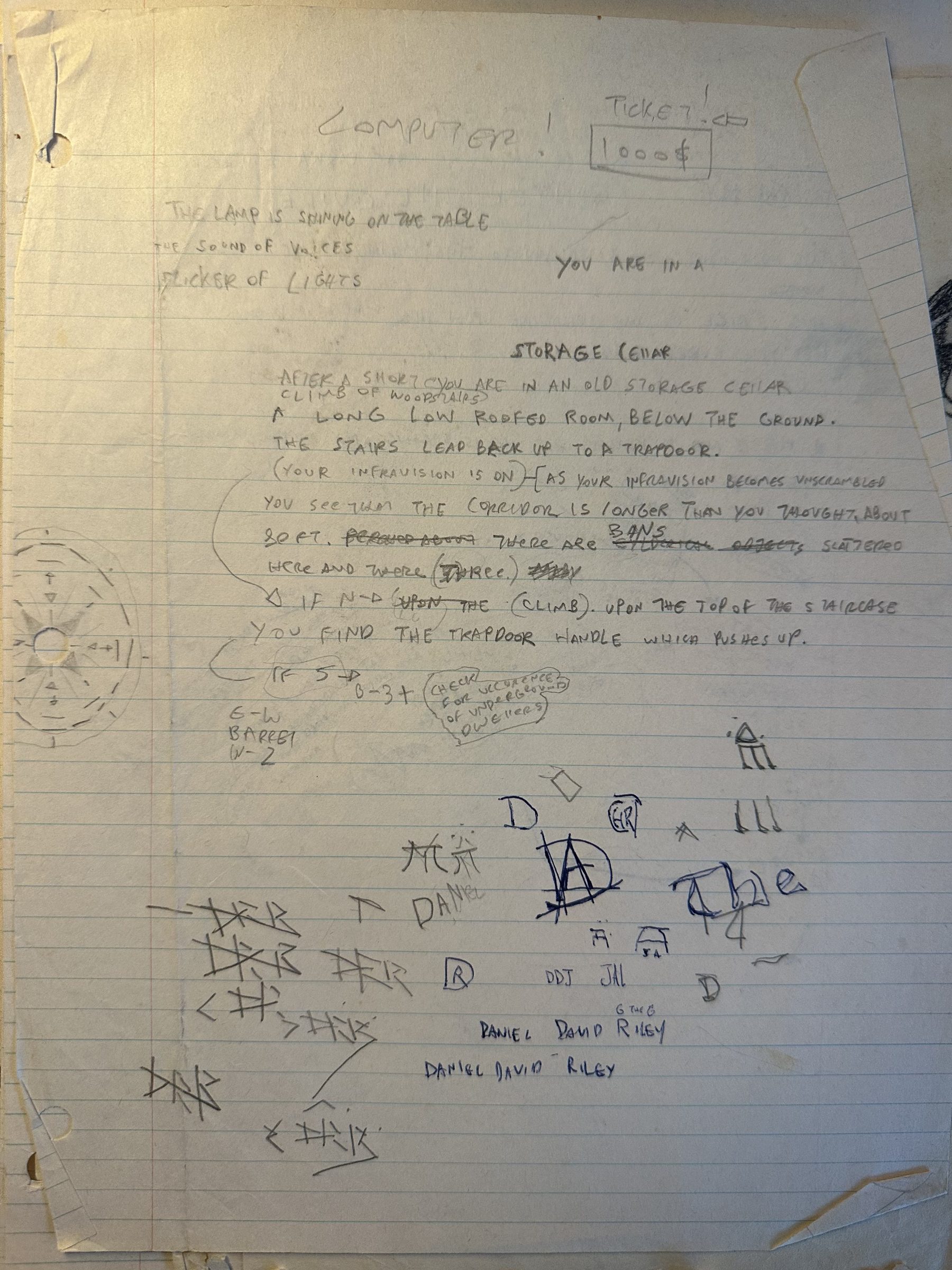
The storage cellar
Room text in the second person: “You are in an old storage cellar. A long low roofed room, below the ground.” A trapdoor, a staircase, a compass rose and lettering doodles.
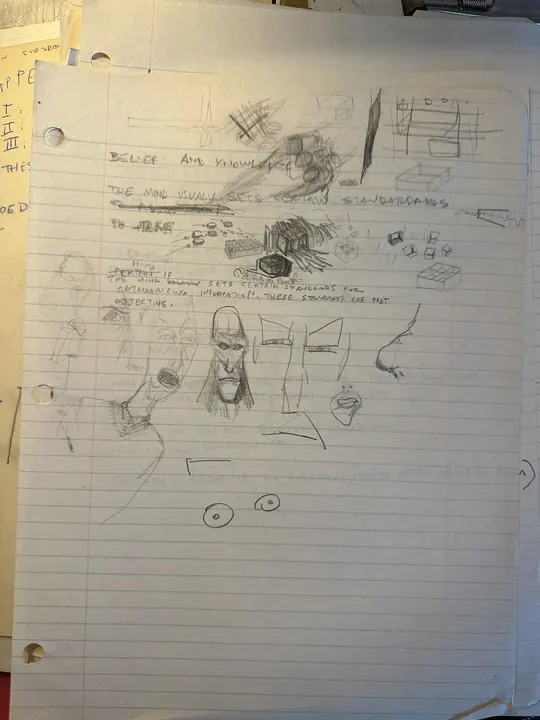 p. 05
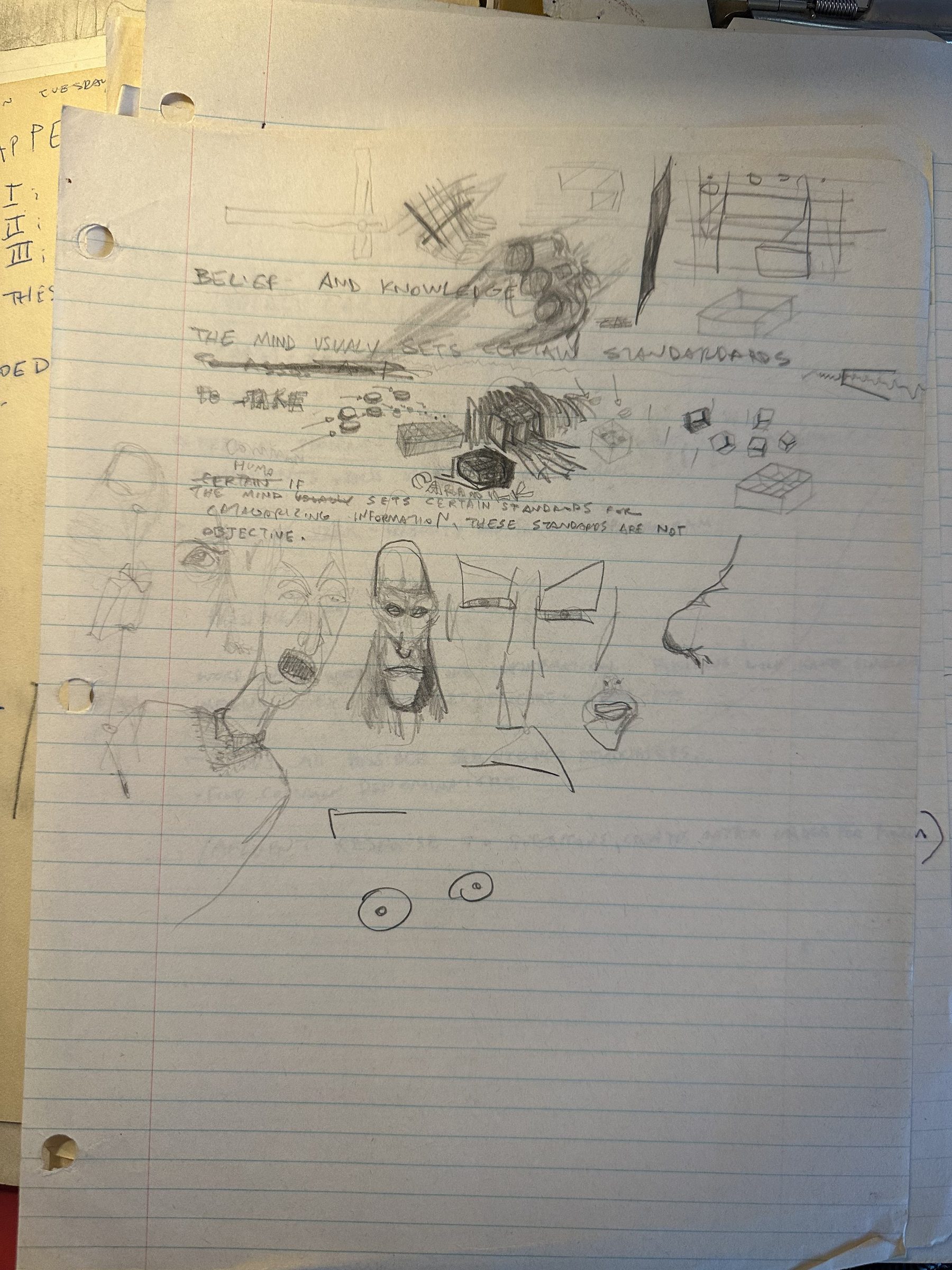
Belief and knowledge
“The mind usually sets certain standards for considering information. These standards are not objective.” Pencil sketches around it.
In the essay: An atom named cat
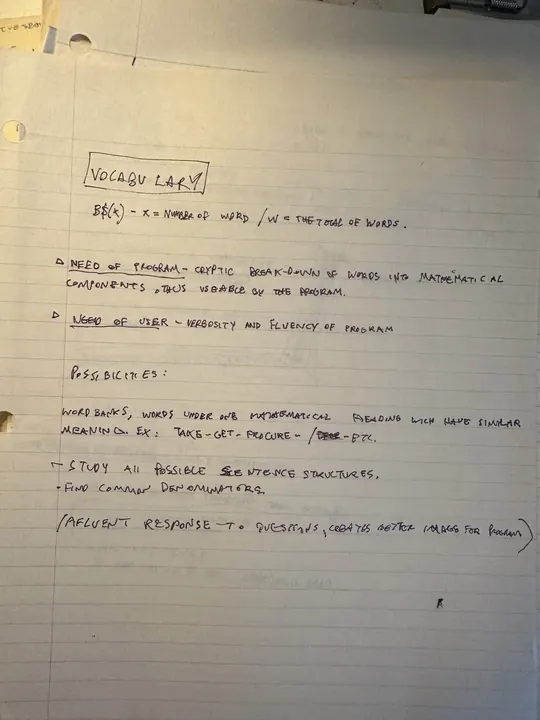 p. 06
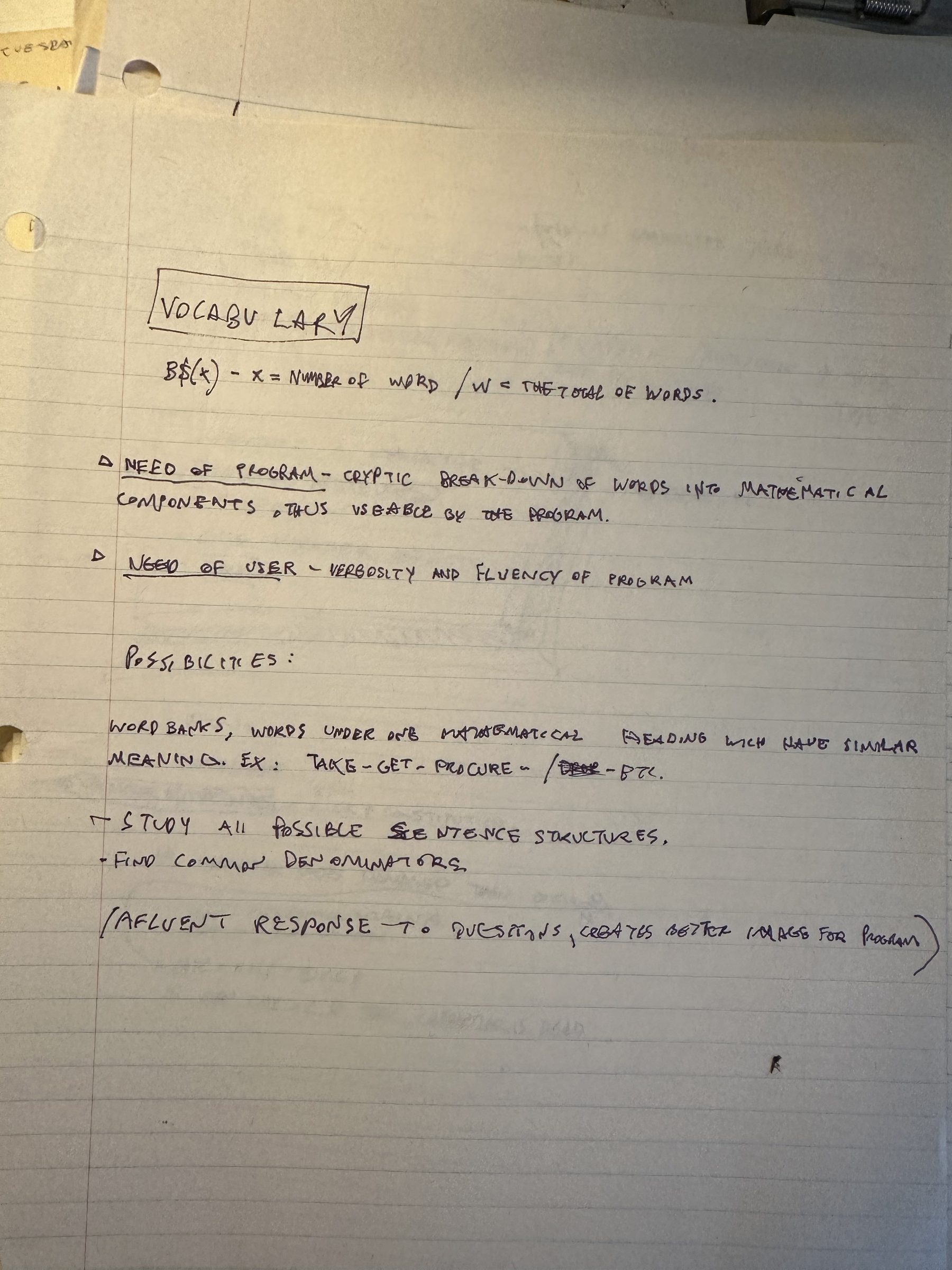
Vocabulary
B(X) as the number of a word; a “cryptic breakdown of words into mathematical components”; synonym sets (take, get, procure); a plan to study all possible sentence structures.
In the essay: Teaching it to listen
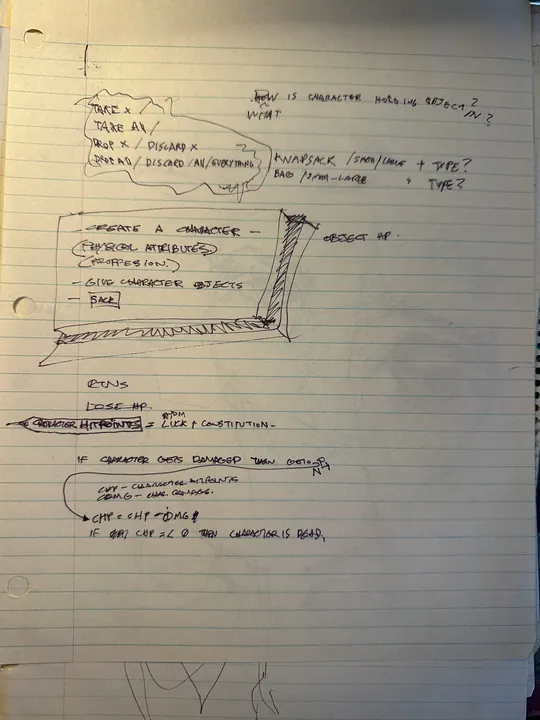 p. 07
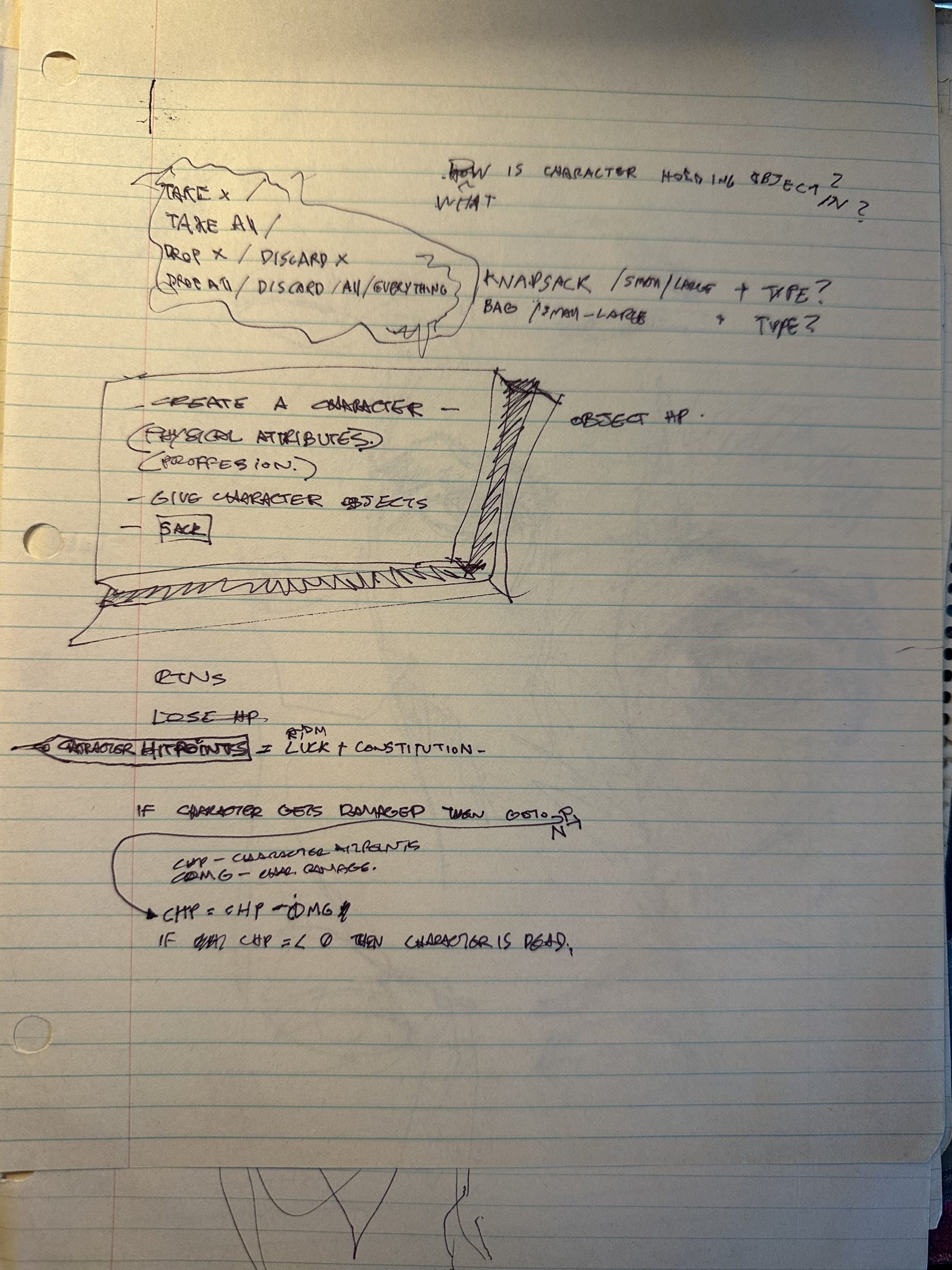
Commands and characters
Take, take all, drop, discard; how a character holds an object; creating a character with physical attributes and a profession; hit points from luck and constitution. “If CHP <= 0 then character is dead.”
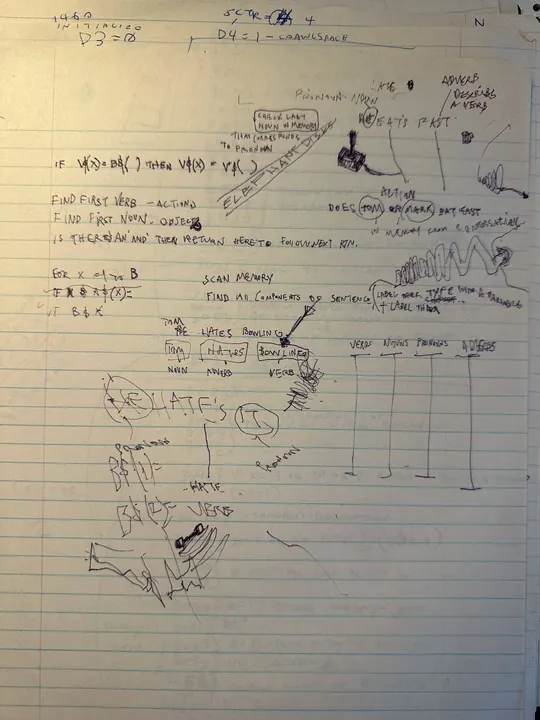 p. 08
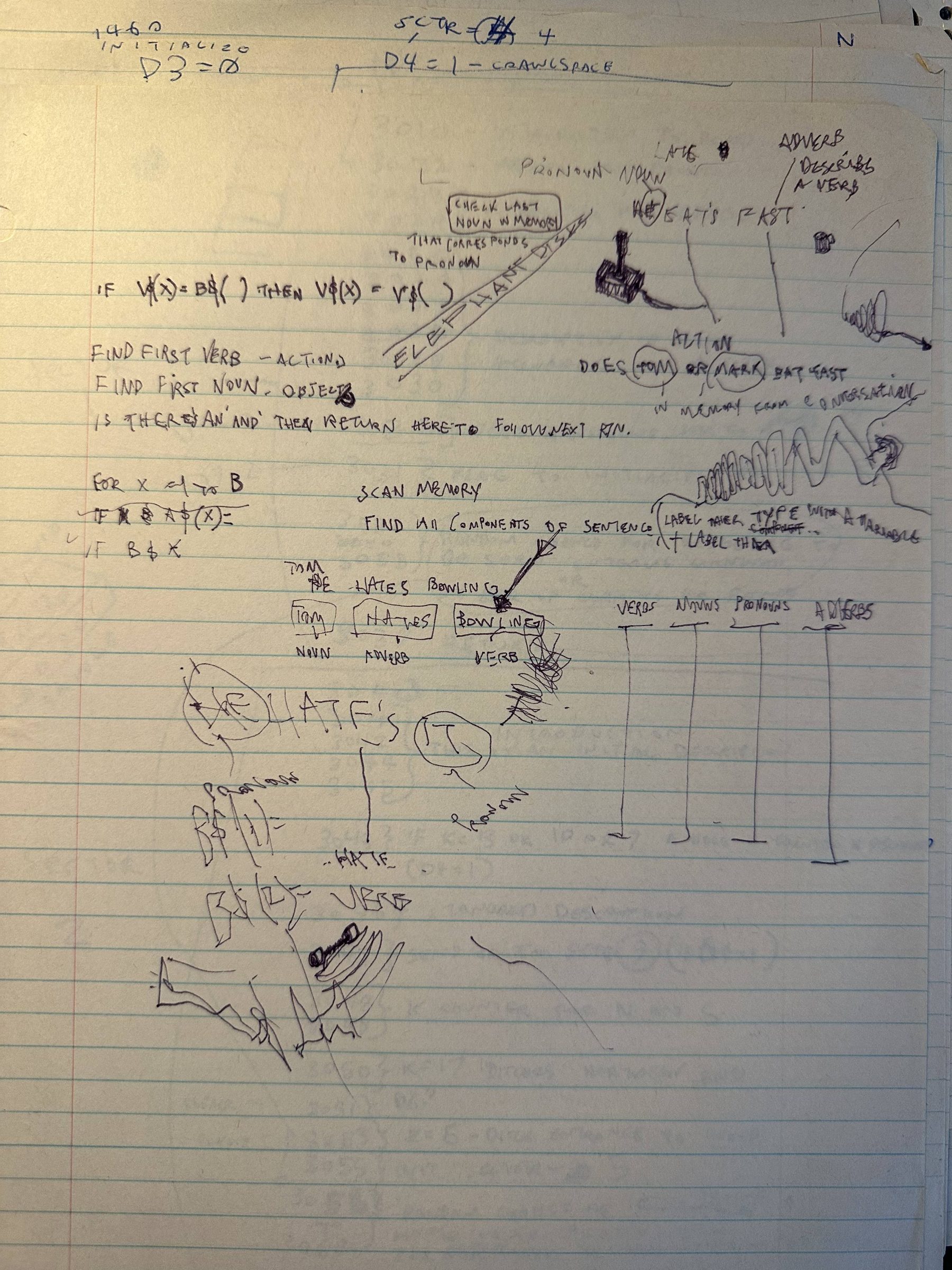
The pronoun rule
“Check last noun in memory that corresponds to pronoun.” Find the first verb and noun; “scan memory, find all components of sentence, label their type with a variable”; columns for verbs, nouns, pronouns and adverbs. ELEPHANT DISKS lettered across the page.
In the essay: What “it” means
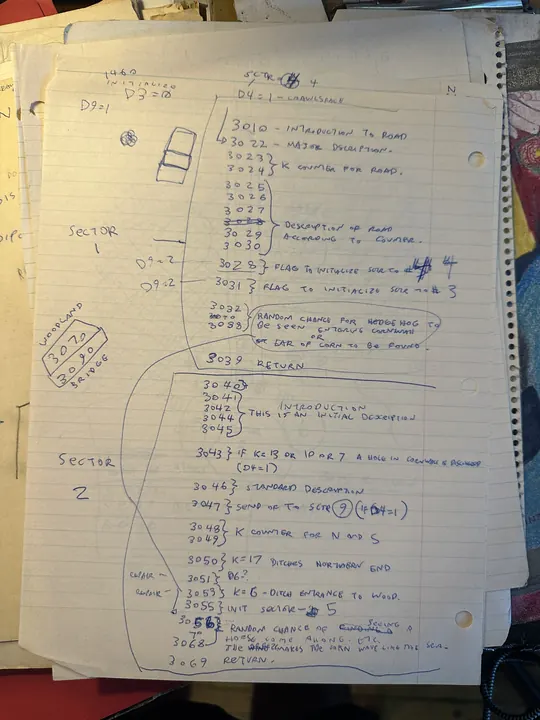 p. 09
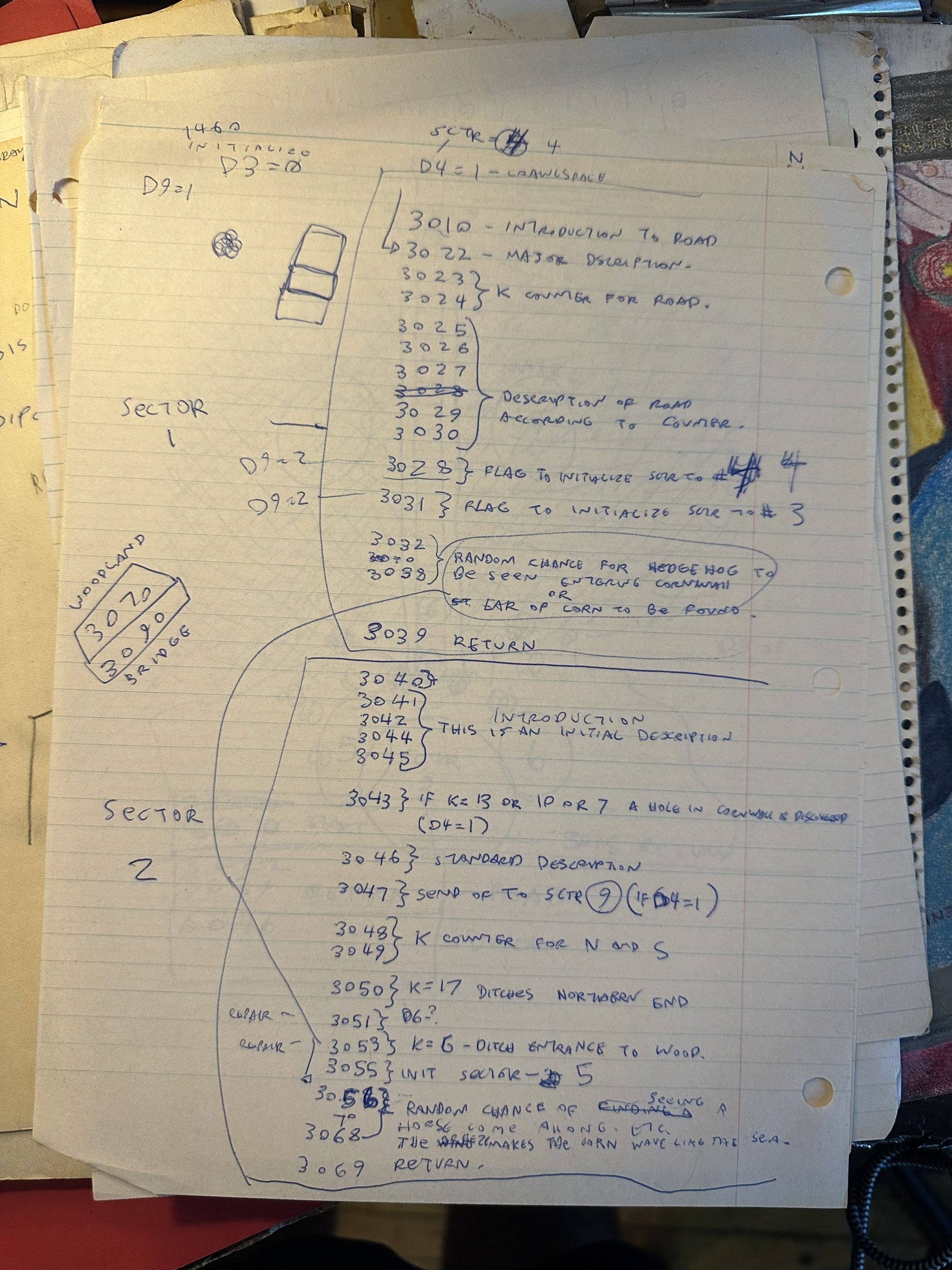
The road, line by line
Program lines 3010 onward: the introduction to the road, sectors, random events, and the hole in Cornwall.
In the essay: A world in 48 kilobytes
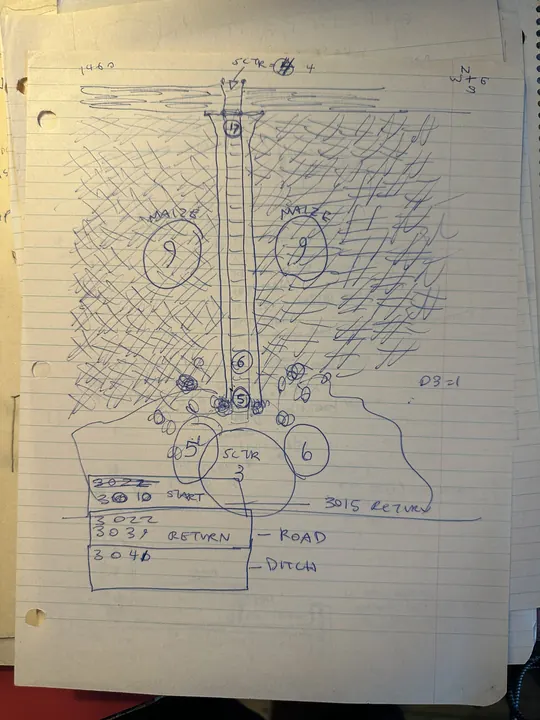 p. 10
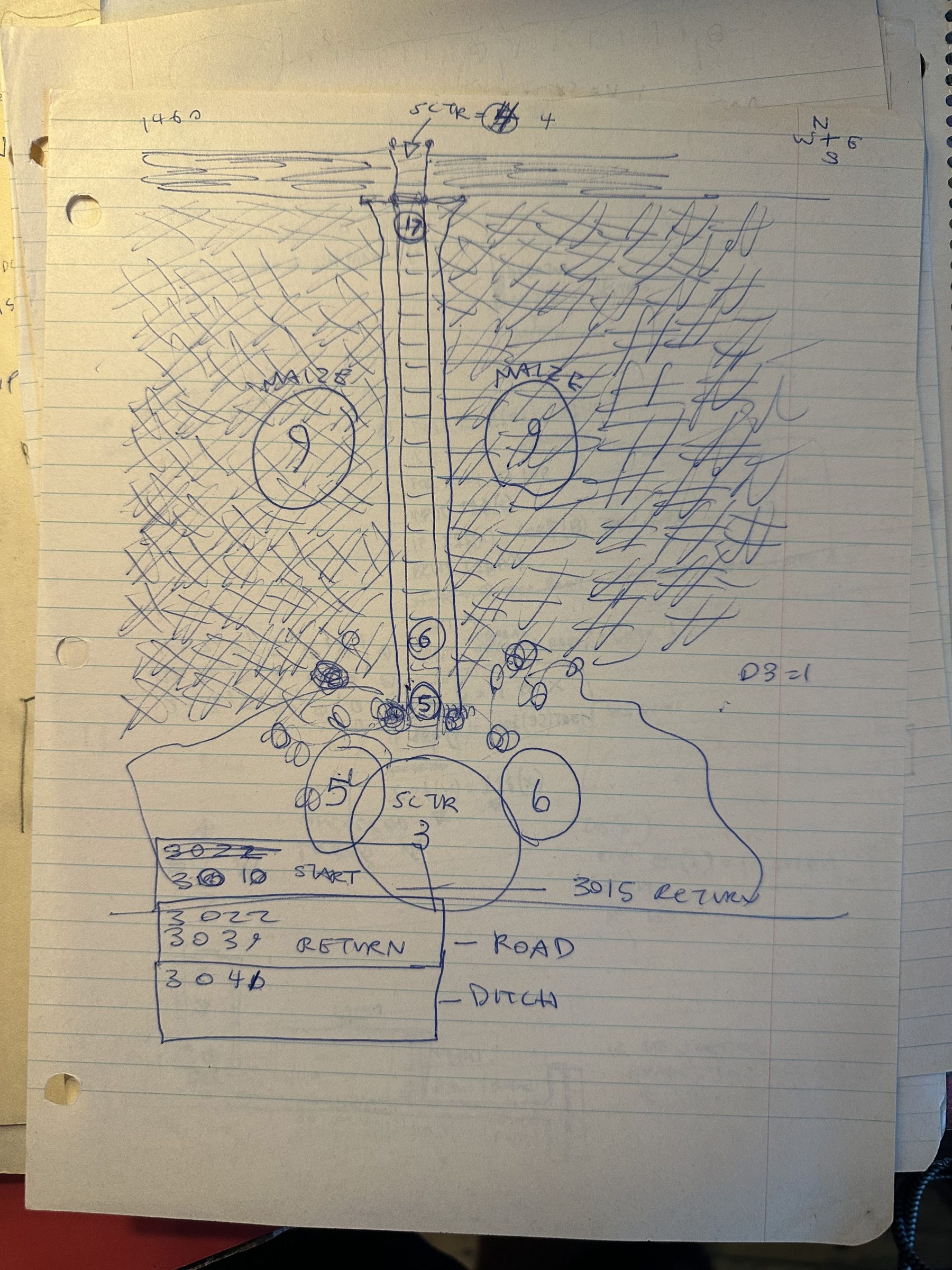
The cornfield
A map of the maize field keyed to program lines: start, return, road and ditch.
In the essay: A world in 48 kilobytes
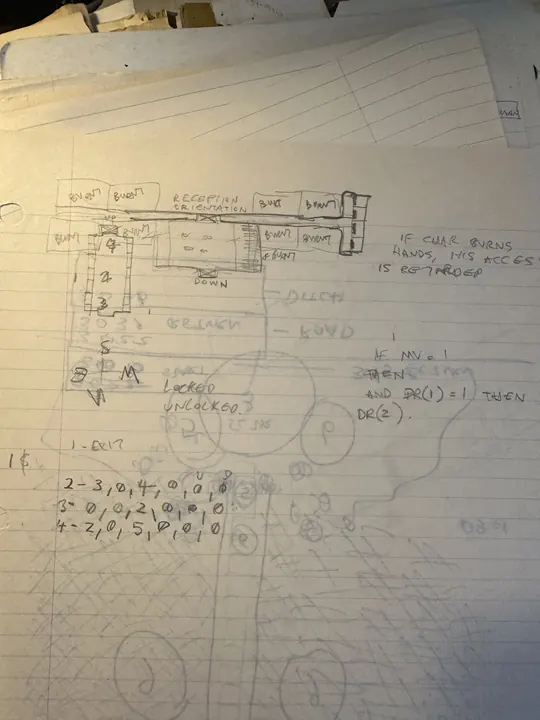 p. 11
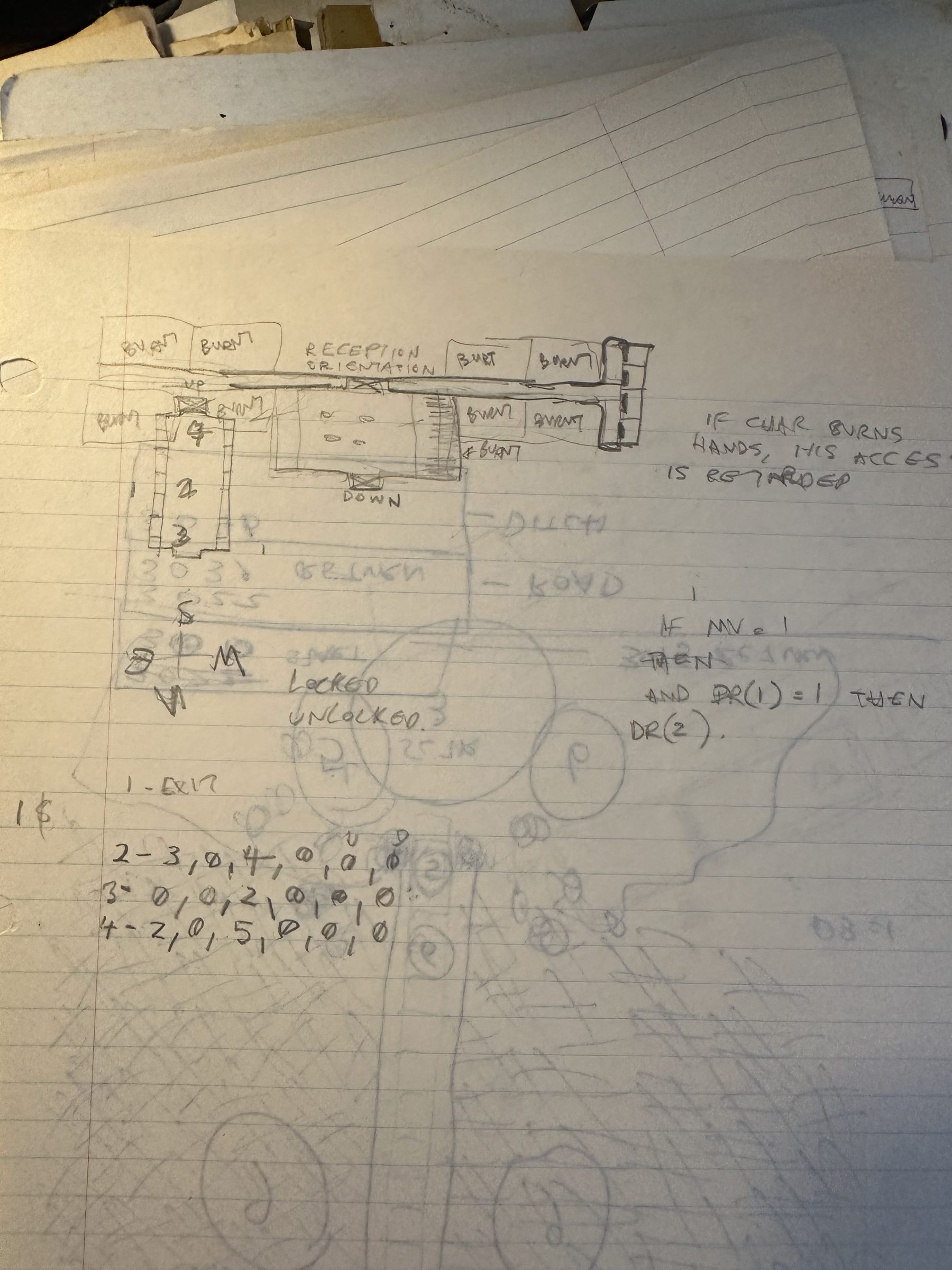
Exits and doors
In pencil: a room layout, the exit table (“1-EXIT 2-3,0,4…”), and door logic (“If MV = 1 and DR(1) = 1 then DR(2)”). “If char burns hands, his access is restricted.”
In the essay: A world in 48 kilobytes
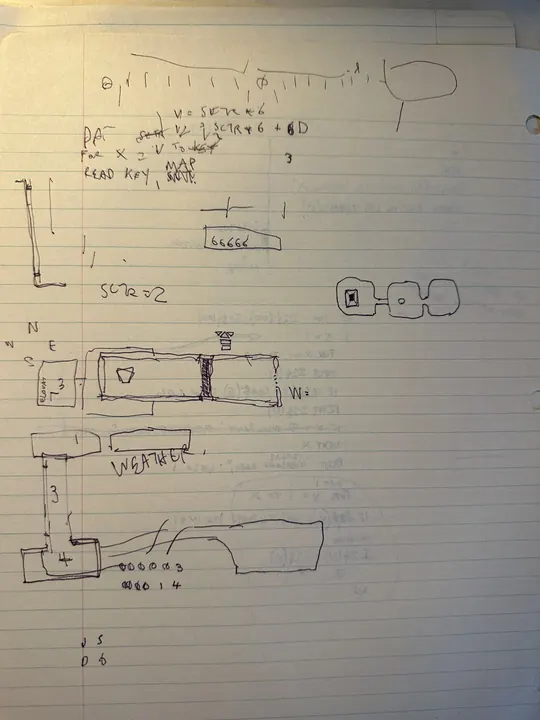 p. 12
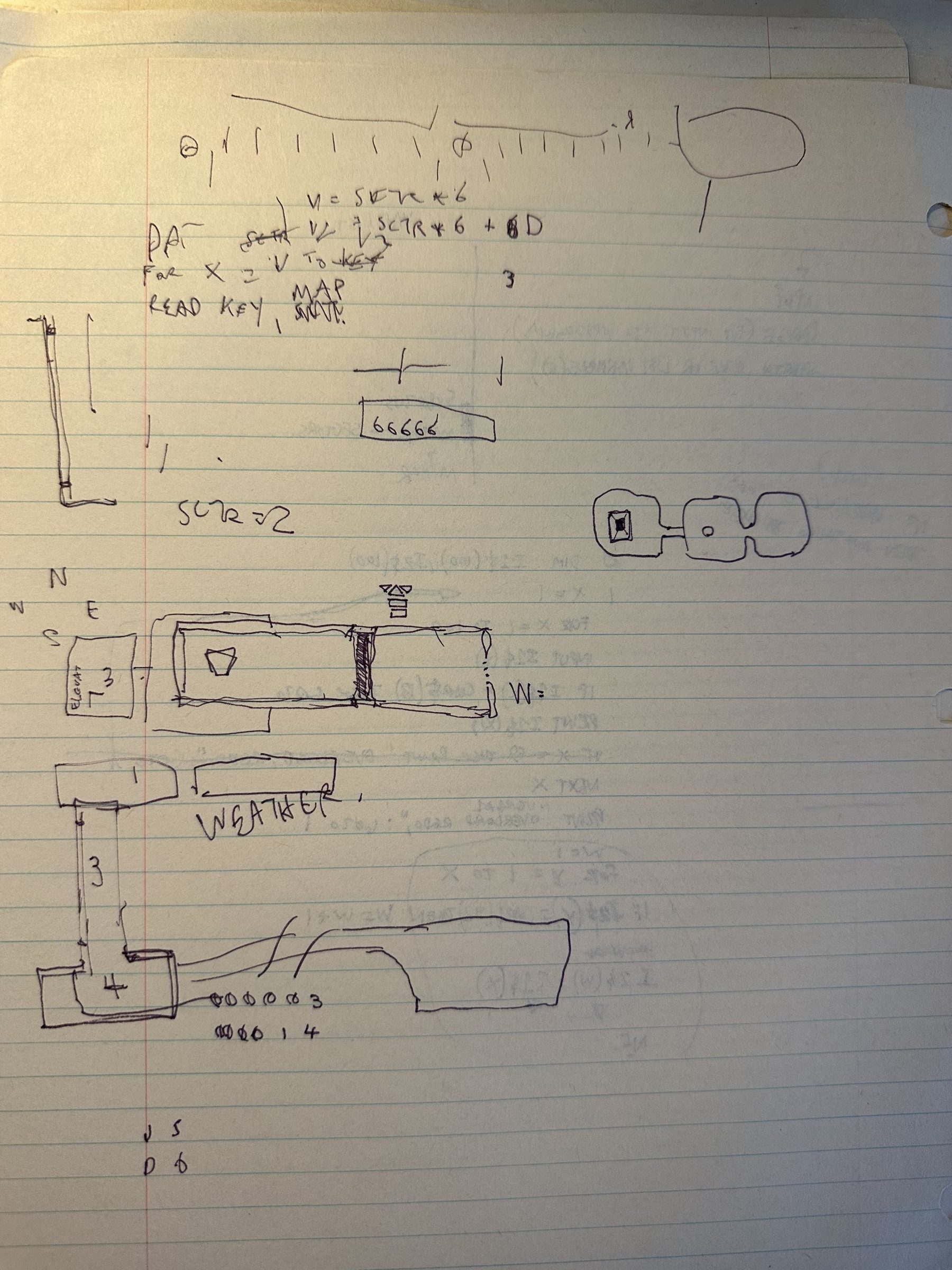
V = SCTR*6
The arithmetic for finding a room’s exits, a key map, and screen sketches for SCR#2 and the weather.
In the essay: A world in 48 kilobytes
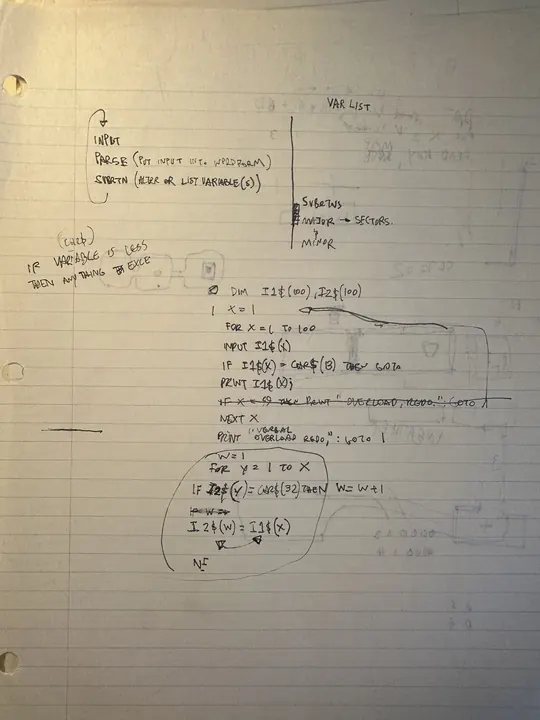 p. 13
Input, parse, subroutine
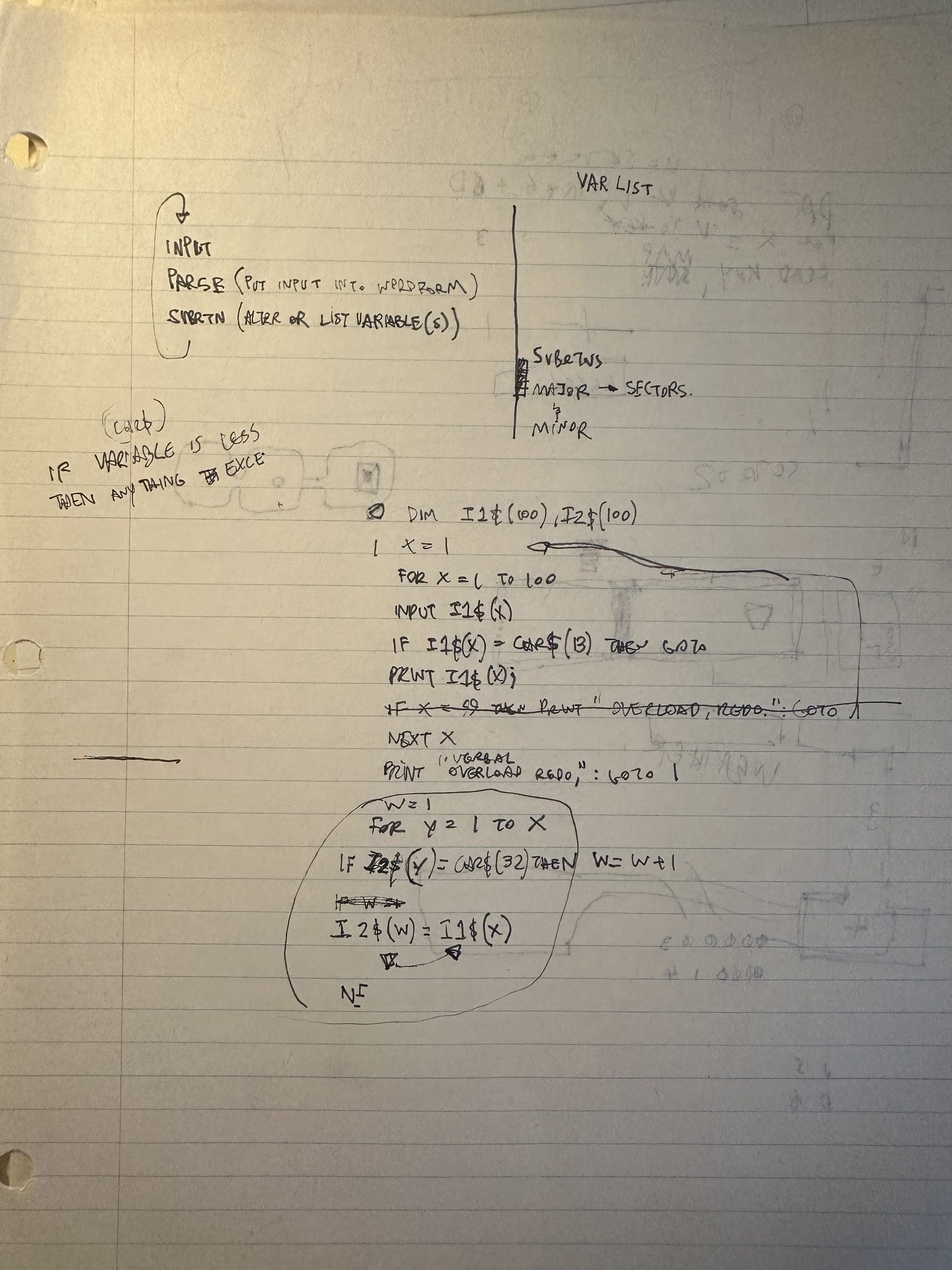
INPUT, PARSE (“put input into wordform”), SUBRTN. Applesoft BASIC that reads the typing into an array and splits it at every space (CHR$(32)), with an overload check.
In the essay: Teaching it to listen
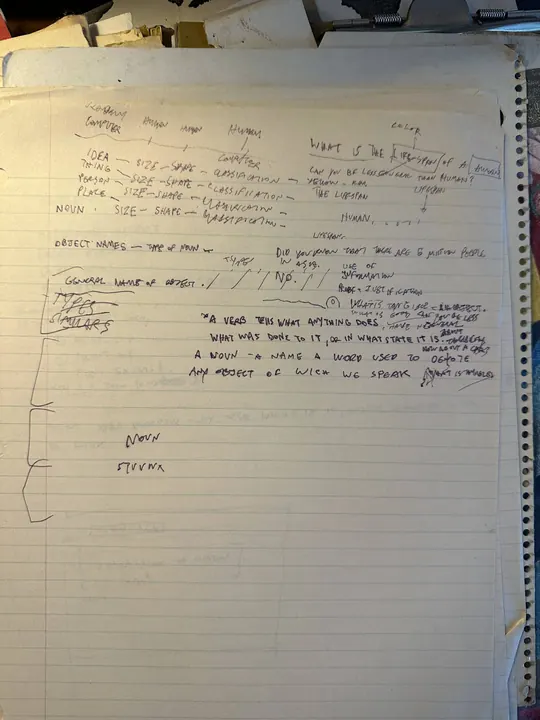 p. 14
Kinds of nouns
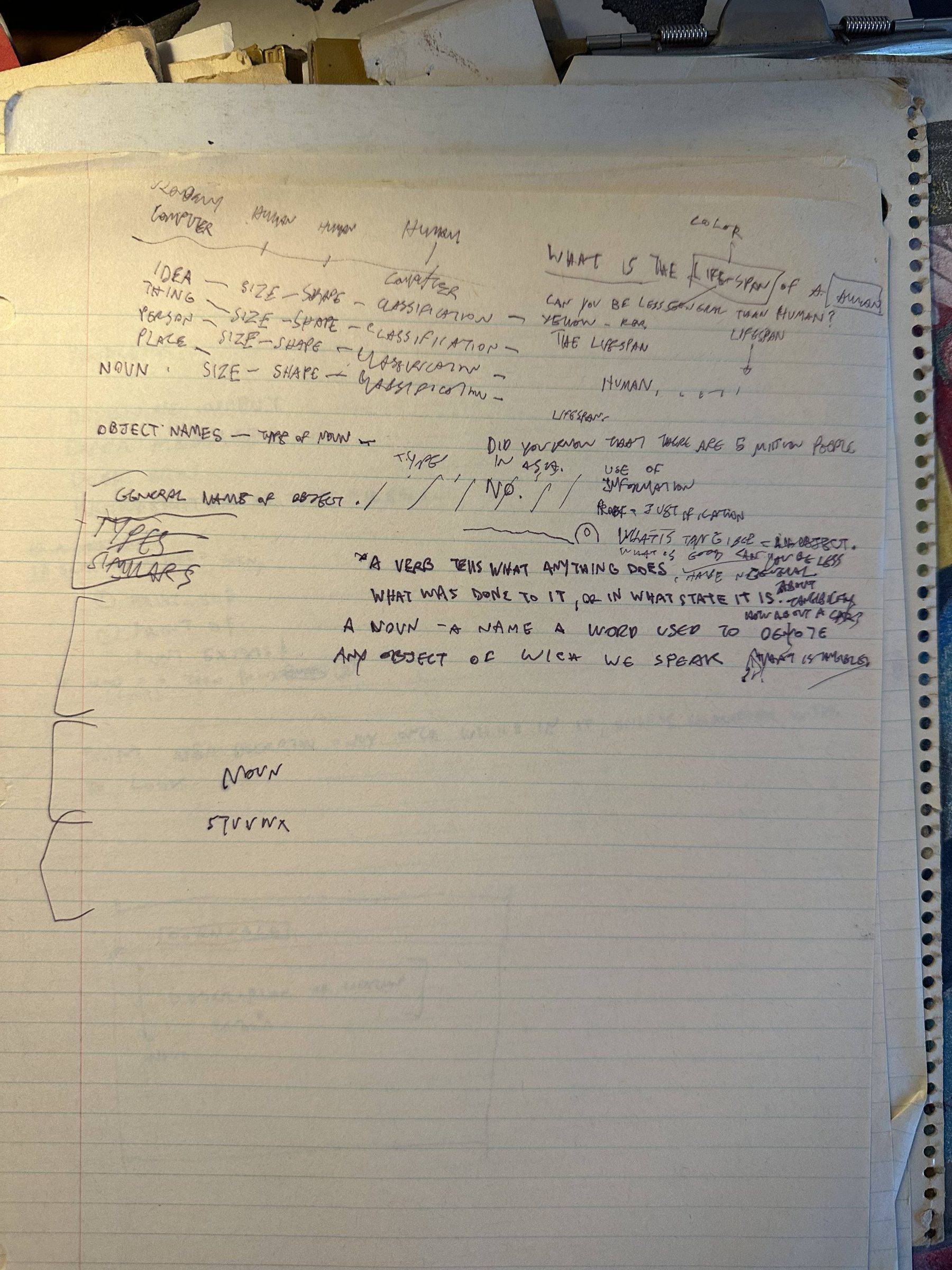
Idea, thing, person and place, each described by size, shape and classification. “What is the lifespan of a human? Can you be less general than human?” Definitions of noun and verb copied out below.
In the essay: An atom named cat
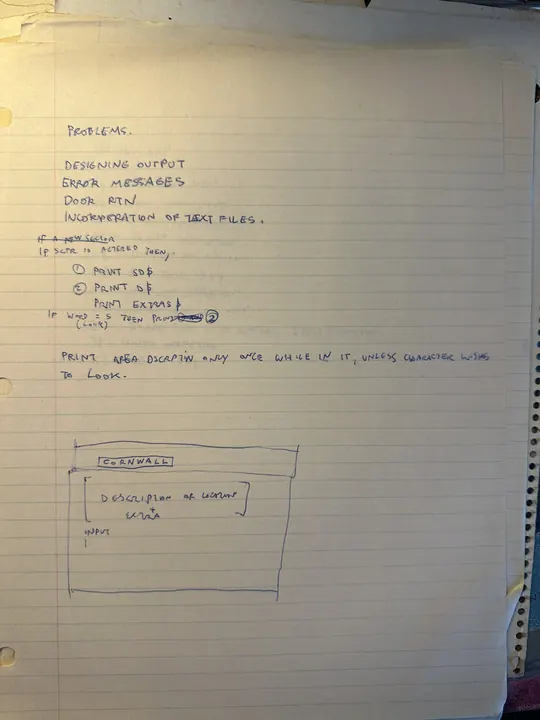 p. 15
Problems
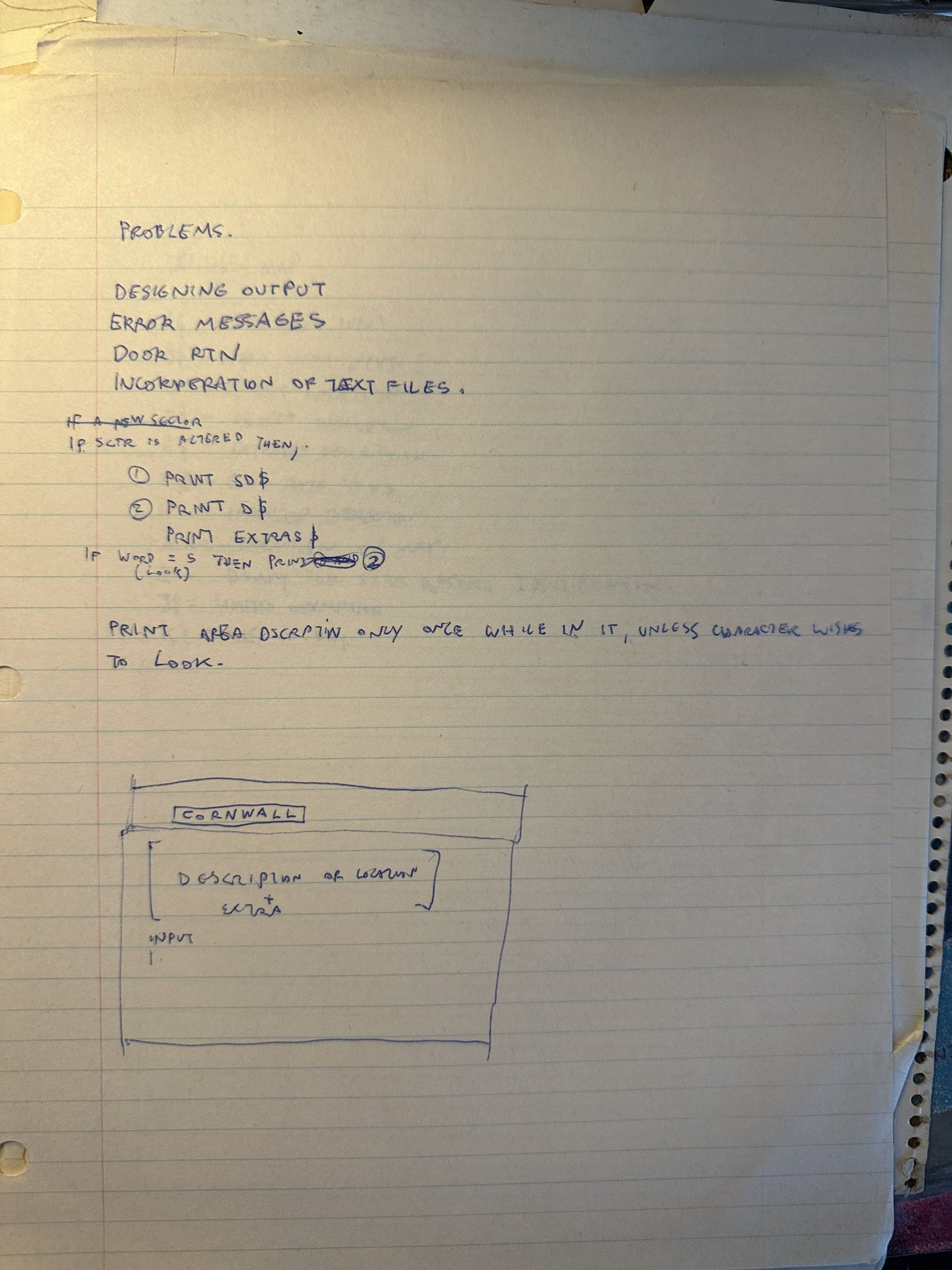
Designing output, error messages, the clock, text files; when to show a description again. A screen sketch headed CORNWALL.
In the essay: The screen is for a person
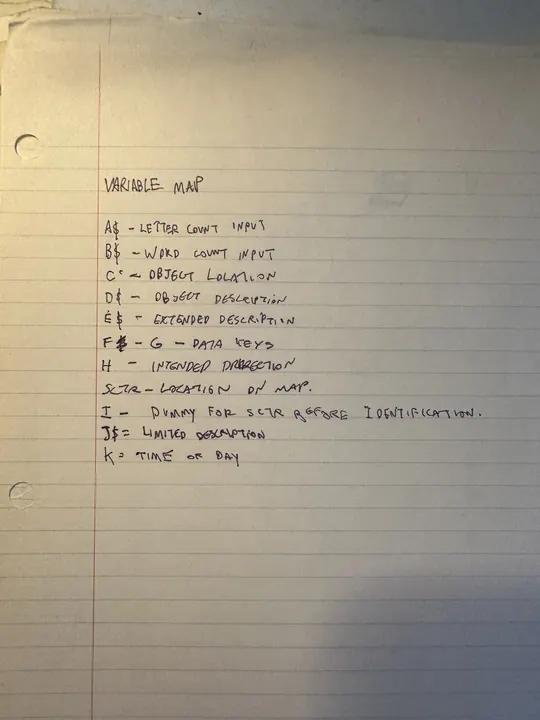 p. 16
Variable map
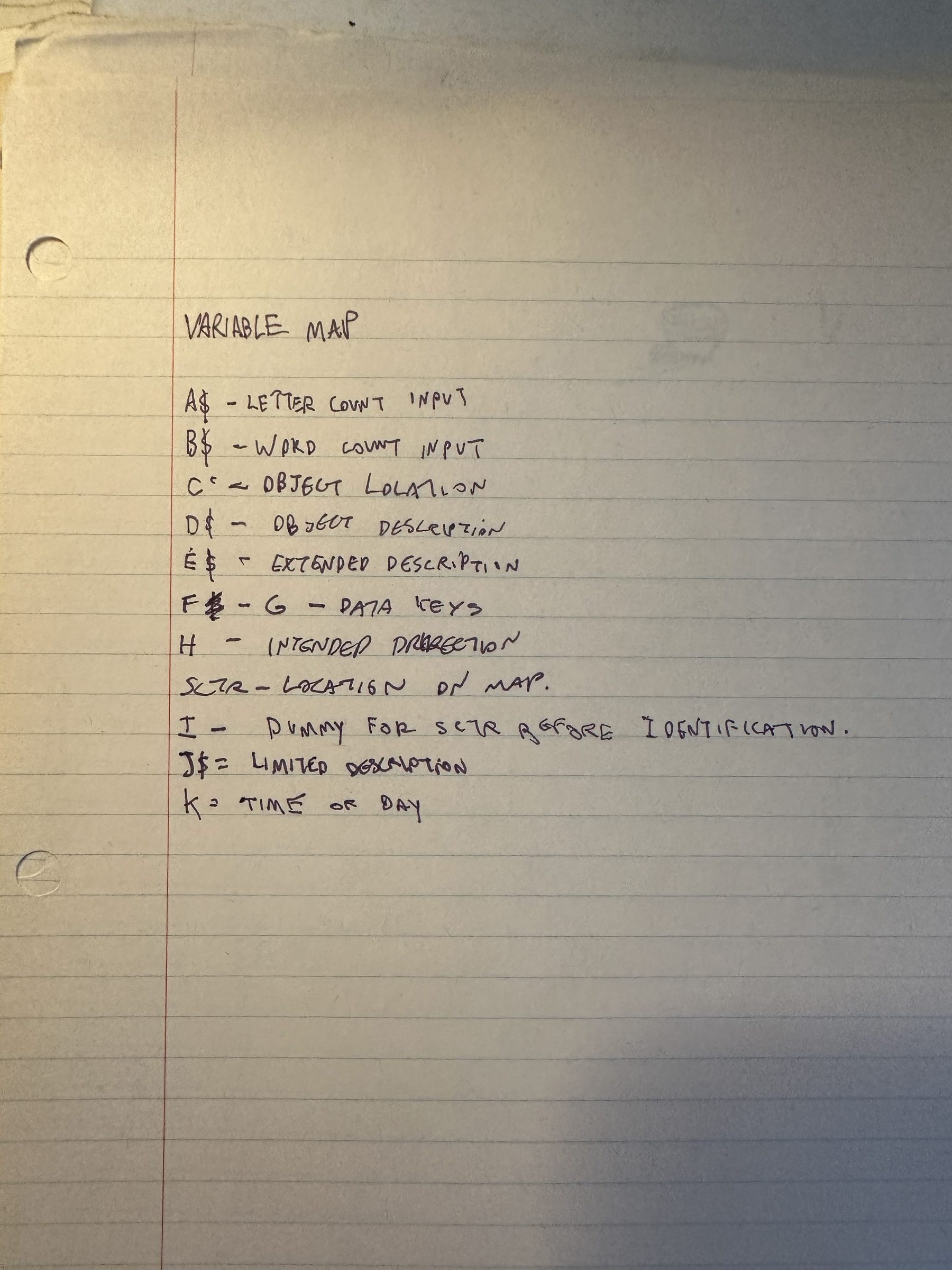
The game’s memory in eleven lines: letter and word counts of the input, object location and descriptions, data keys, map sector, time of day.
In the essay: A world in 48 kilobytes
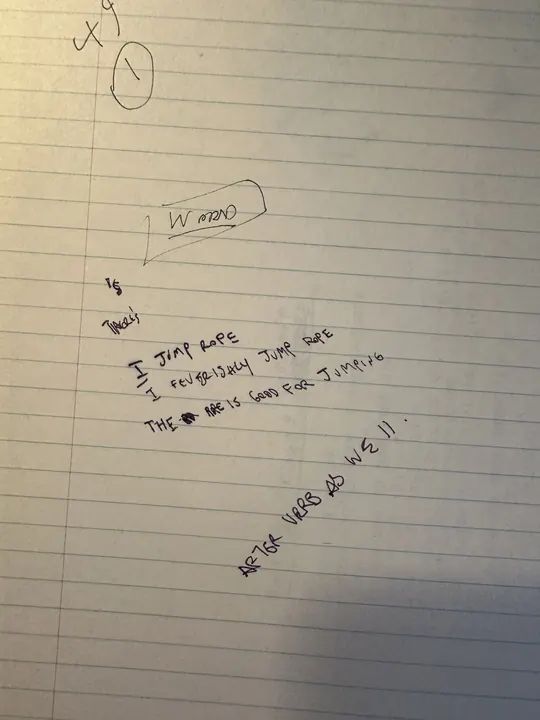 p. 17
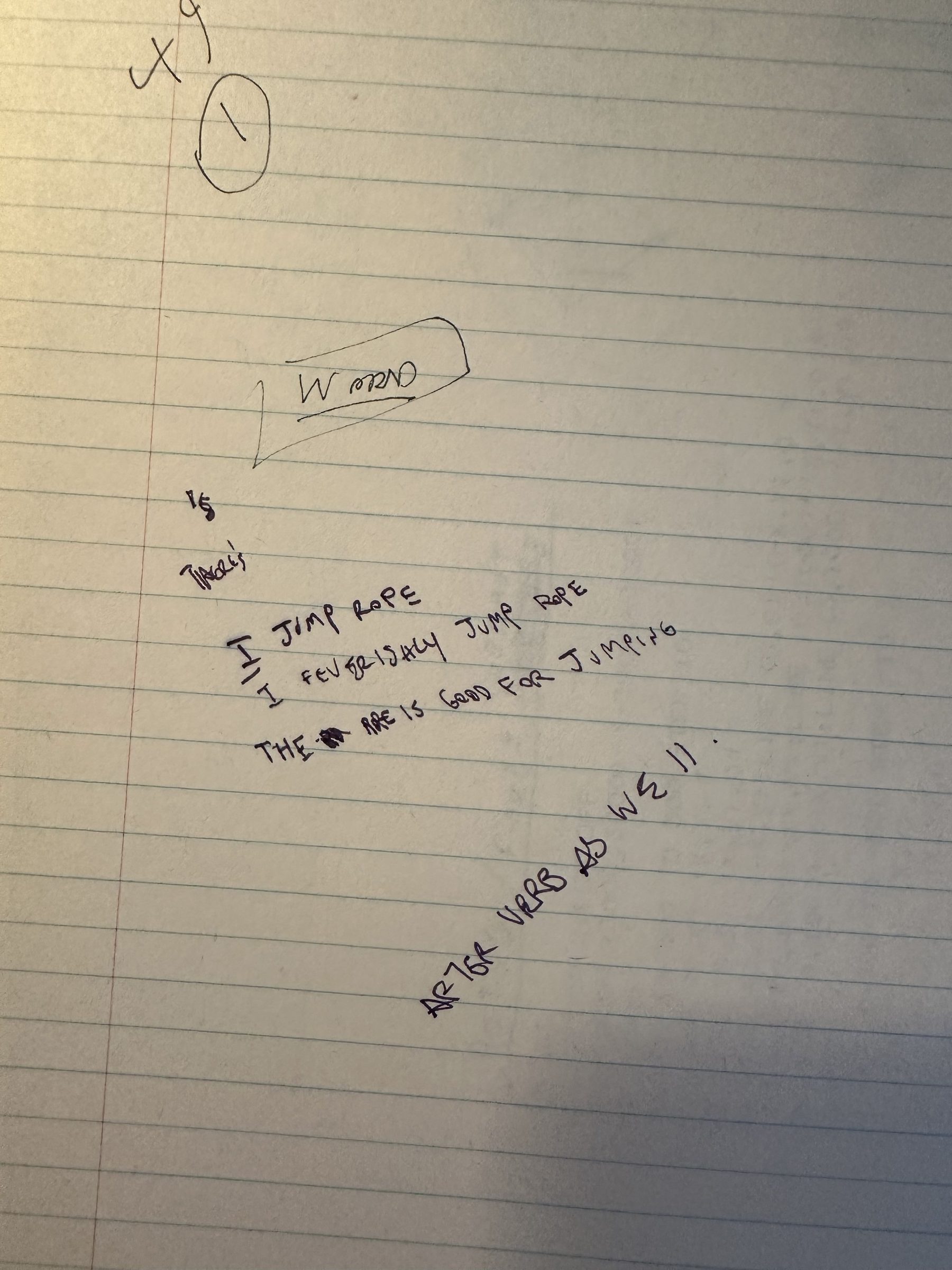
I feverishly jump rope
“I feverishly jump rope. The rope is good for jumping.” The same word as action and as purpose.
In the essay: Teaching it to listen
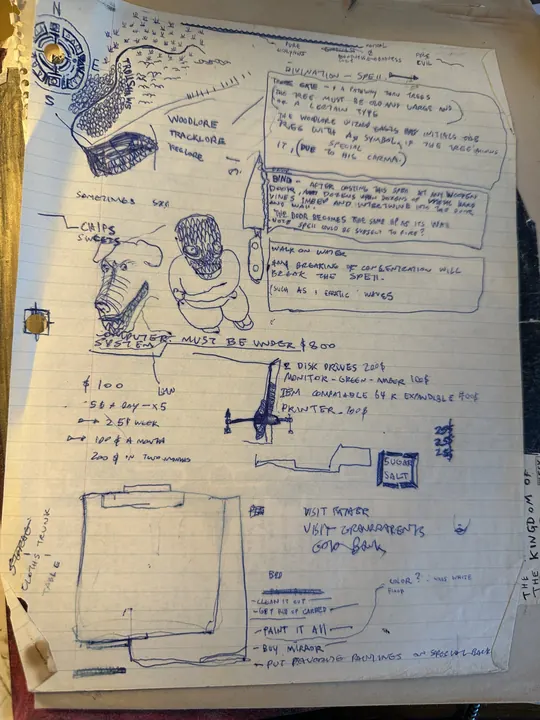 p. 18Later page
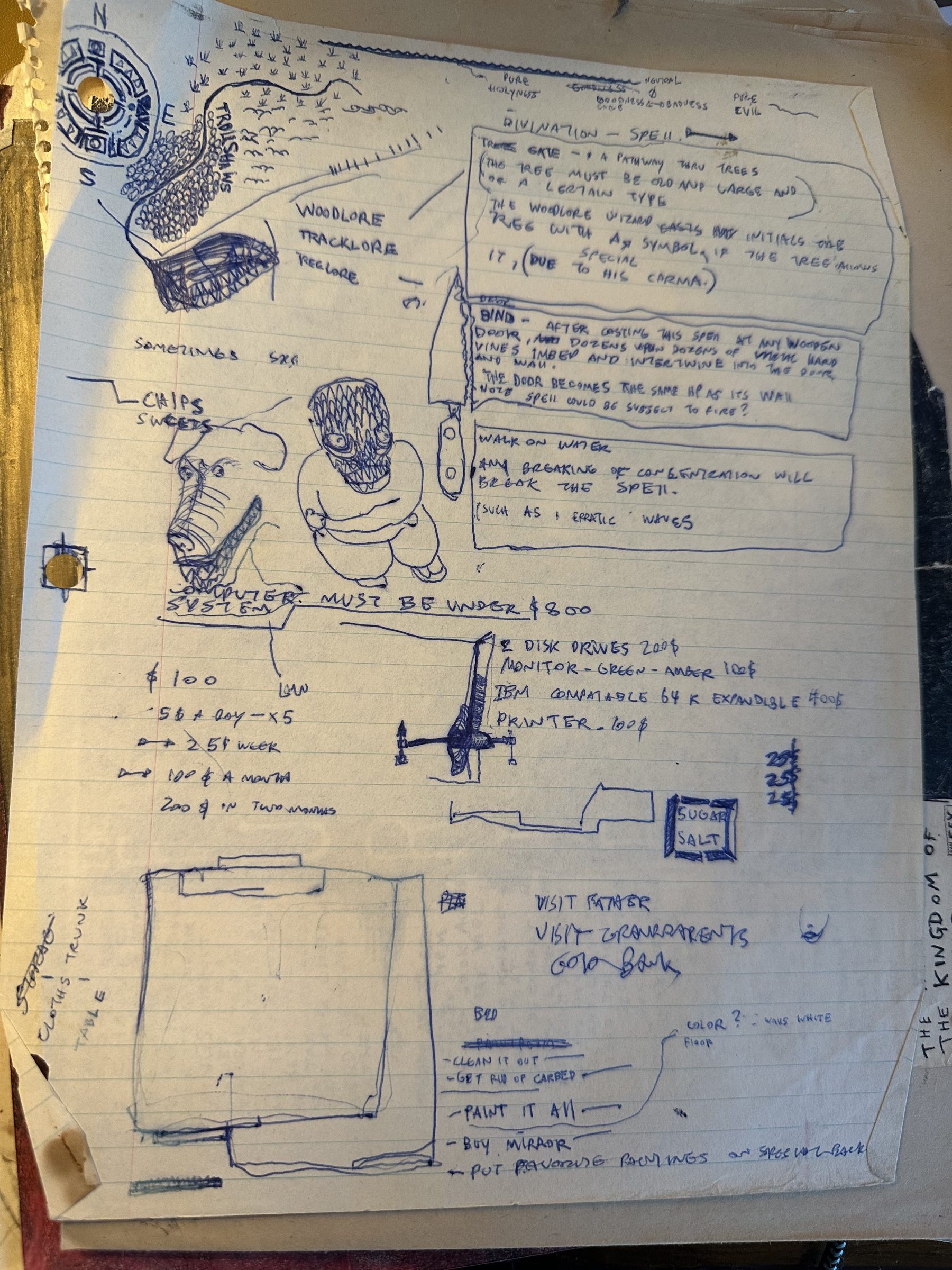
Spells, and a computer budget
Spells (divination, bind, walk on water), woodlore and sketches. It also prices an IBM-compatible computer, which puts this page later than the rest. It’s here so the record is complete; nothing in the essay depends on it.
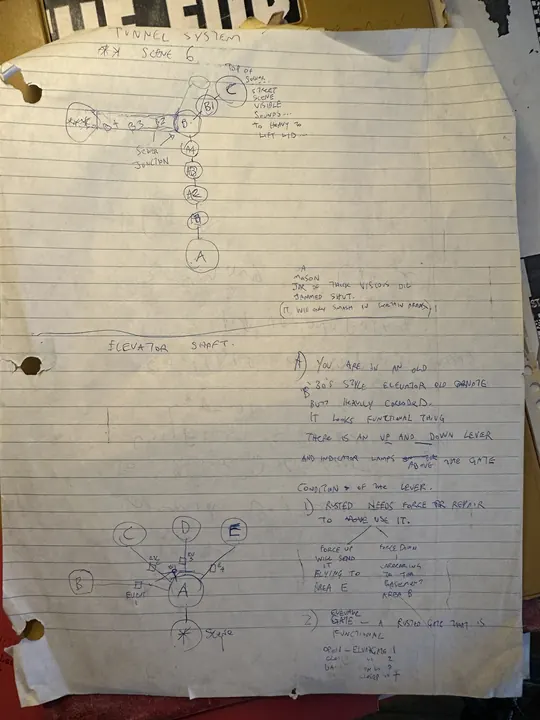 p. 19
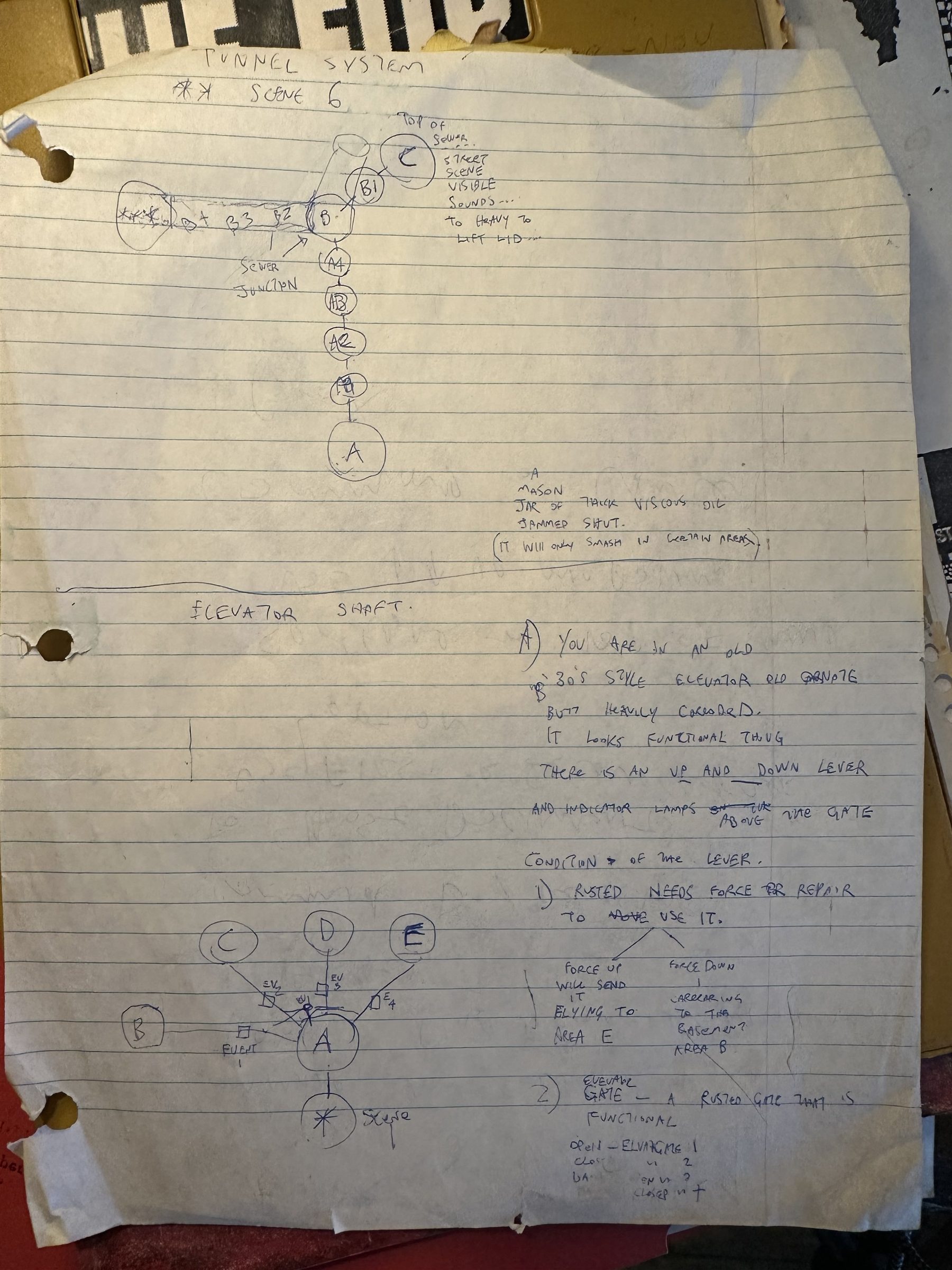
Tunnel system, scene 6
Rooms drawn as a graph, and the elevator: “You are in an old ’30s style elevator… heavily corroded.” An up-and-down lever and what happens to each.
In the essay: A world in 48 kilobytes
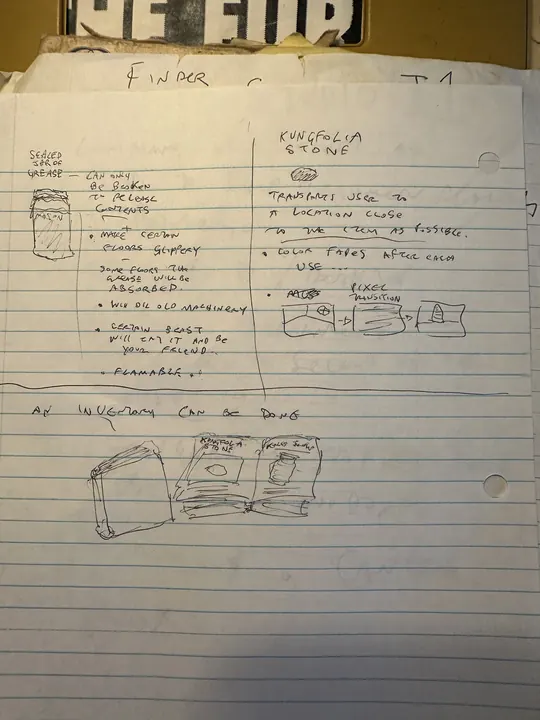 p. 20
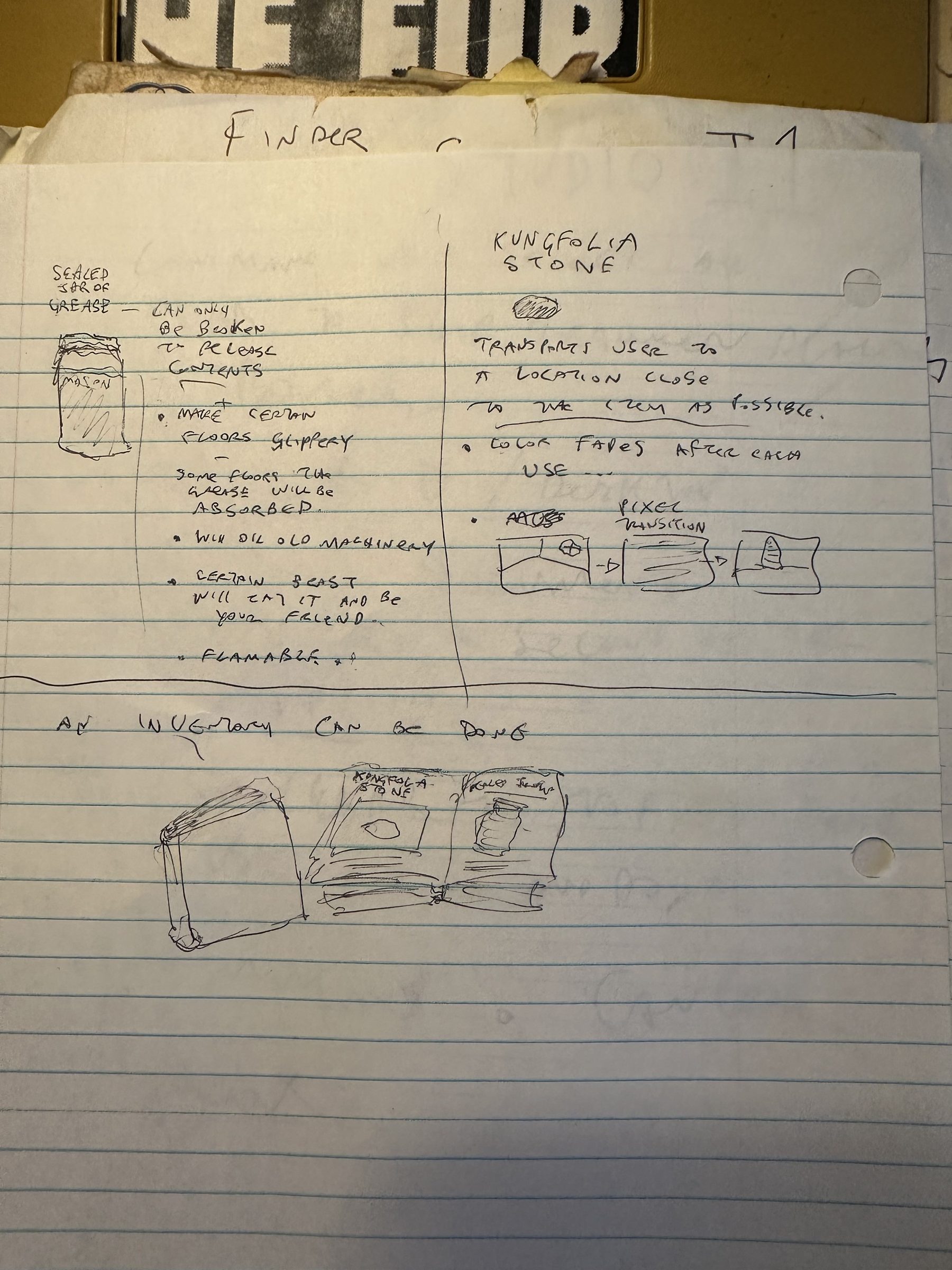
Finder
A sealed mason jar of grease and what it does when broken; the Kungfolia stone, which transports the player. “An inventory can be done.”
In the essay: A world in 48 kilobytes
From the notepad
One page from a yellow notepad of the same years, quoted in the essay. The notepad’s other pages are poems and personal writing and aren’t reproduced.
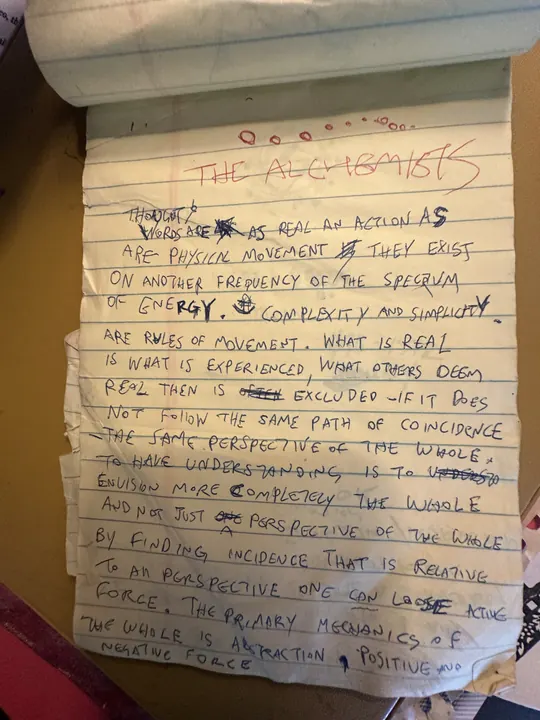 Notepad
The Alchemists
Notes on energy, movement and perspective, from a yellow notepad of the same years.
In the essay: The veil
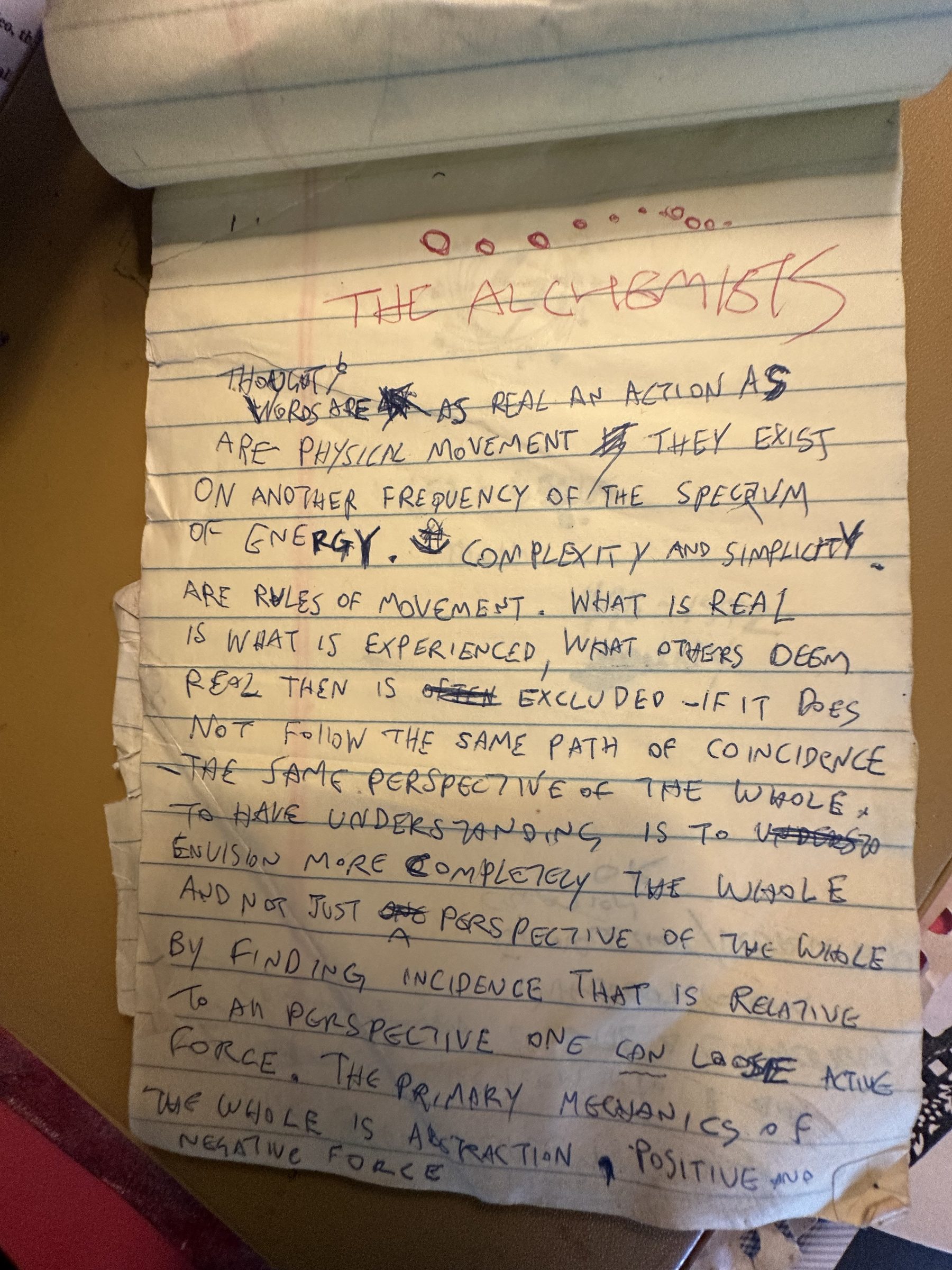
Not shown
A printout of IBM PC BASIC code. It’s later than these years, and the essay doesn’t use it.
How to cite a page
Daniel Riley, Apple II programming notebook, Rosemère, Quebec, 1981–82, p. 08. Photographed July 23, 2026. https://danielriley.ca/writing/the-silicon-door/notebooks/#p08
Every page has its own link. Use the “Link” under any page to point to it directly.