Before the Playbook
How a crew of filmmakers, game designers, hackers and hustlers built a full-stack creative shop in Toronto before most of the industry knew it needed one, and how LCI became my road into enterprise UX.
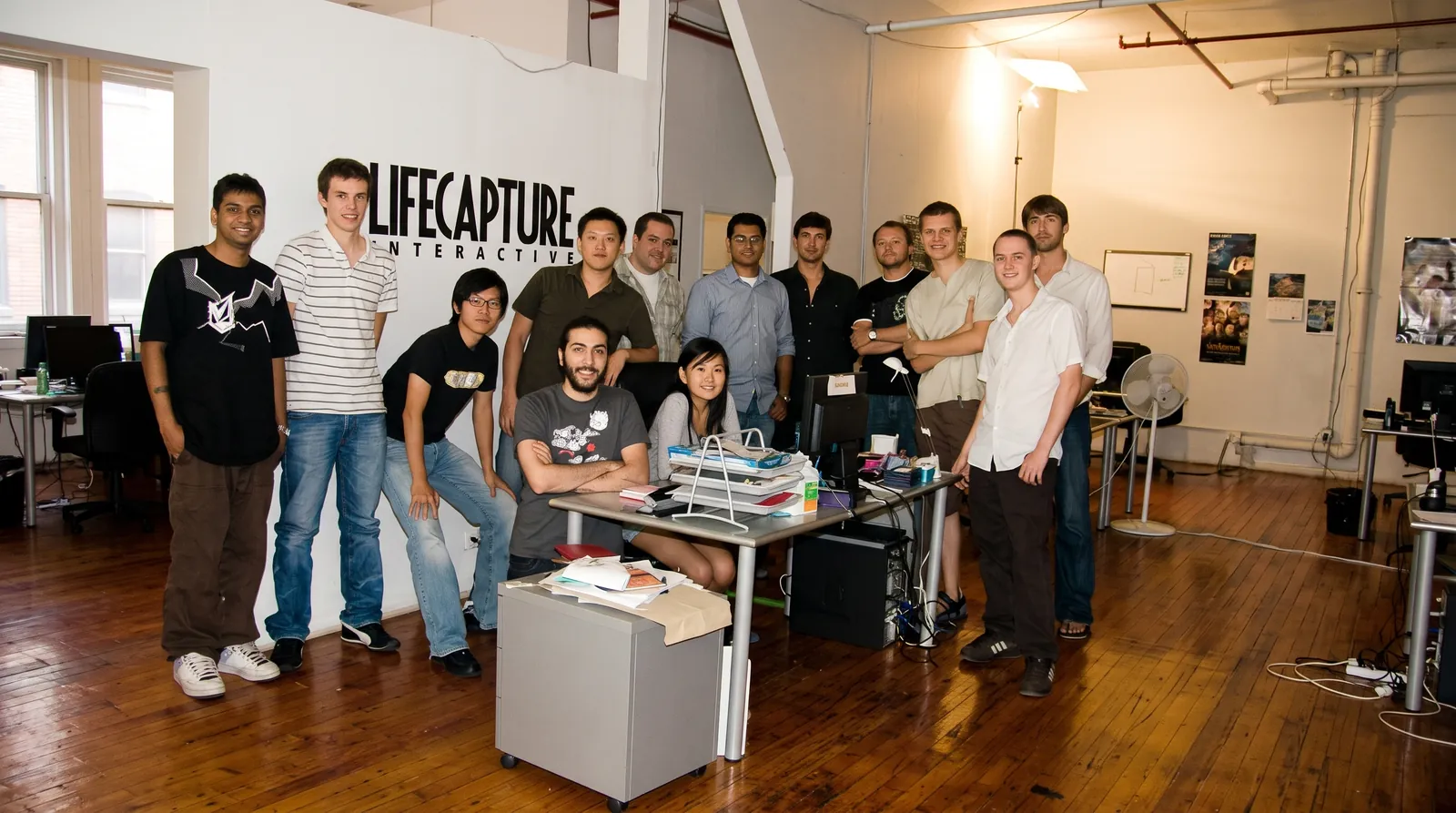
Three companies that didn’t talk to each other
In 2004, making a brand come alive online in Toronto took three companies that barely spoke the same language. The ad agency owned the client and the idea. A production house shot the film. An IT shop built the site — on time, on spec, and usually lifeless. Every handoff bled something out of the work.
We started Lifecapture Interactive in a loft at 263 Adelaide Street West to collapse that chain into one room. Filmmakers. Game designers. A film composer. Coders who treated software limits as suggestions. And business people who could walk all of it into a boardroom and sell it.
Nobody handed us a playbook. We wrote it as we went — fast, cheap, stubborn, and by the seat of our pants.
We weren’t alone in seeing it. A small club of independent studios — North Kingdom in northern Sweden, B-Reel in Stockholm, Big Spaceship in Brooklyn — was proving the same thesis: the web could be cinematic, playable and commercial all at once. LCI was Toronto’s entry in that club. We built it with less money, thinner pipes and more nerve.
The proof came later, from the market itself. Within five years, the traditional marketing industry was buying shops like ours, because it couldn’t build them.
Forcing the web to be cinematic and interactive
My route in wasn’t webmastering. I came out of game design and visual effects for film, by way of Queen Street’s post-punk scene. I didn’t see a browser as a document. I saw a stage — something you could light, score, and let people play.
That was the brief we founded the company on. Two of my co-founders, the brothers Jordan and Josh Eady, brought a photographer’s eye and a filmmaker’s instinct for story. My own brother, Jeff Riley, our principal 3D modeller, added the third dimension. We shot live-action video and high-end photography, then built it into interfaces that behaved more like games than pages. The browser became a camera lens and a game engine at the same time.
Film and television brought the first real budgets: a quarter of a million dollars for a companion site built to live through a single release window. That was serious money for marketing at the time, and we spent it like a production budget, building worlds rather than websites: a game-style interactive video experience for the TV series Crash Addicts, the companion to CBC’s Who Do You Think You Are?, and a full interactive video environment for ZOS: Zone of Separation, the Gemini-nominated war drama. Each one pushed the technology of the day as far as it would go.
Then we gave it a soundtrack. Most Flash sites of the era looped a stock track. Ours were scored by James Mark Stewart, a film composer and sound designer whose credits now run to 26 feature films and seven TV series. He won SOCAN’s Achievement in Music Award for The Riverbank and a Genie nomination for his sound work on the Oscar-nominated In Darkness. Picture, play and sound — built together, in one room.
Pirate engineering
Our ideas kept hitting the same wall: the 2000s internet wasn’t built for them. Bandwidth was thin, real servers were expensive, and Flash — the platform the creative web ran on — had hard ceilings nobody was supposed to cross.
So we cheated, in the best sense. A horse-racing client needed live race video streamed over the web in real time, while people were betting on it, and the server hardware to do it properly was out of our reach. Jeff emptied store after store of every Xbox on the shelf, and Phil Mullis, a systems engineer who could make any box do any job, wired them into our own compute farm. We ran the stream on game consoles. It worked. We kept the farm and pointed it at every heavy job that came after. Phil never lost the habit. Years later, when the internet in his corner of rural Ontario couldn’t keep up, he put up an 80-foot tower, started trenching fibre and became the ISP himself.
The code side ran the same way. Brendan Sera-Shriar, our Flash technical director, came out of the open-source world: he contributed to Papervision3D, the engine that put real-time 3D inside Flash, and to Red5, the open-source server for streaming Flash video. Ryan Andal pushed just as hard from his side of the room. Between them, Flash got wired to whatever back end could carry the load — Ruby on Rails included, while Rails was still young.
None of it came from a textbook. It was pirate engineering, and it shipped.
Work that moved the business
The test was always the same: did it move the business?
For Alliance Atlantis, we were the interactive agency of record, launching films like No Country for Old Men. For Control, Anton Corbijn’s film about Joy Division’s Ian Curtis, we hid an obscure video online and turned the launch into an Easter-egg hunt. Fans found it, passed it around and pulled huge social attention to the film, back when YouTube was new and nobody had a playbook for it.
For the Shaw Festival, we produced scripted, scored video campaigns that sent viewers straight into online ticket sales — performance marketing before it was an industry buzzword. For Daniels Corporation’s Festival Tower, Jeff and I built animated walkthroughs of the suites from the architectural plans, so buyers could tour a condo that didn’t exist yet. Virtual suite tours are standard in the condo business now. We were building them by hand.
The campaign that best proves the thesis was Spot the Sponge, for Kruger’s SpongeTowels. It was a big-budget build, and we ran it the way we ran everything: film, marketing, interaction design and game mechanics in one integrated piece. It deployed at scale, and it worked.
The agency that owned Kruger’s account was furious and threatened to sue. We had walked straight through the walls the industry was built on, and that was the point. Advertising was organized into separate houses that guarded their lanes and couldn’t integrate a campaign between them.
We integrated one anyway.
The work had a voice, too. Corporate web copy in those years read like a terms-of-service page. Ours was written by Cavvie, a satirist who’d written for Ed the Sock, and it had attitude.
That mattered more than anyone expected. YouTube arrived in 2005; Facebook opened to everyone and Twitter launched in 2006. Overnight, brands needed a voice that could talk back. We already had one, and we folded each new platform into client work as it landed.
The commercial engine
None of it would have mattered if it didn’t sell. My co-founders Geoff Whitlock, our CEO, and Matthew Tautt made sure it did. They drove across the country to sit in boardrooms that weren’t sure what “interactive” meant, and came home with signed work. Our partner Sanjeev Desai, an accountant by trade, kept the numbers honest, executive-produced Crash Addicts, and helped build the growth PROFIT would later rank.
We hired for the same hunger. When Trina Boos joined as a client strategist, Matt told the Toronto Star her job was “to find businesses that need our services.” She came from Creative Niche, a digital recruitment firm, and she’d already built Ad Lounge from a Sheridan College networking group into a community of more than 5,000 people. We weren’t hiring a résumé. We were hiring an entrepreneur.
The work got bigger. We rebuilt Rexall’s national website, built some of Loblaw’s first interactive work for President’s Choice Blue Menu, and took on mandates for Microsoft, Roots, Greenfield Global and the City of Toronto. The pirate studio had become an enterprise shop without losing its edge.
LCI paid for itself. Every hire, every render, every rack of Xboxes came out of profits, right up to the day we sold. It began as a handful of us in a small studio under the roof at 263 Adelaide, with more nerve than résumé between us, and it grew only as fast as the work could carry it. By the end, we had 25 people and most of the floor.
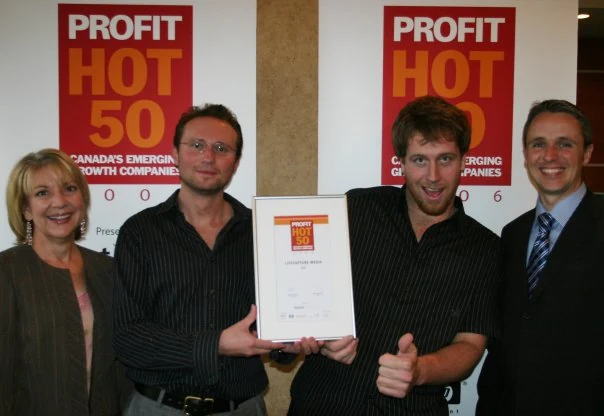
The industry noticed. PROFIT magazine ranked us — as Lifecapture Media — on its HOT 50 list of Canada’s emerging growth companies two years running. In November 2008, the Canadian New Media Awards named me Designer of the Year, in a field that included Vincent Morisset, the Montreal director behind Arcade Fire’s interactive videos. The same night, LCI’s Postcards from Crystal was a finalist for Excellence in Cross Platform.
The sale, and where everyone went
In March 2009, with the recession at its worst, Arlene Dickinson’s Venture Communications bought us to put every marketing service under one roof. The deal took in LCI and Motorcycle Productions, the film company Jordan and Josh ran as our sister shop. Venture was then about 75 people across Calgary, Toronto and Ottawa, with an estimated $45 million in gross sales. Dickinson’s advice to business owners that spring was blunt: “Don’t be afraid.” She’d just shown she meant it.
It wasn’t a one-off. In 2007, WPP had bought Vancouver’s Blast Radius, a 350-person interactive shop, to build out its digital capability. The pattern was plain: the traditional industry was buying the integrated digital model rather than building it. I went with the deal and spent the next two years inside Venture. Cavvie came too.
Not everyone took the same road. By then the industry’s gravity had flipped. Big, established companies were running on systems built for another era, and as they began to replatform, they came looking for people who could make technology feel human.
We never chased enterprise work. It came to us.
Part of our crew wanted to stay out on the experimental edge of marketing and entertainment instead. James Milward and Ryan Andal, with Noora Abu Eitah and several of our best people, built Secret Location. It went on to win an International Digital Emmy, then the first Emmy ever awarded to a virtual-reality project, and eOne bought it in 2016. One crew, two headings: one into the enterprise, one out on the edge. Both were right.
We were all young. Most of us were early in our careers, and none of us had done this before. My job on the creative side was to find people who could outdo me in their own lane and had no fear of the unknown, then get out of their way. The other founders hired the same way on the business side. We were all in the same boat, on the same frontier, figuring it out together.
It turned out to be an all-star cast. Here’s where the people who cut their teeth at LCI went:
What LCI taught me
Here’s the thing I’ve carried into every job since: you can’t design a great experience without understanding the machine underneath it. The Xbox farm and the broken Flash ceilings weren’t side stories. They were the lesson.
I’d learned early that the way forward runs straight through the limits of the tools. Before LCI, I led game design at I. Hoffmann + Associates, the Toronto studio whose Nikolai’s Trains Apple bundled with its Performa home computers. On Gord@k, our Myst-style 3D adventure, we broke Macromedia Director, the go-to engine of the CD-ROM era, and then Apple’s QuickTime VR, to stitch rendered worlds into seamless 360-degree walkthroughs wrapped in stereo sound.
The experience is the technology.
What we did by instinct didn’t have a name in most of the rooms we worked in. The phrase “user experience” had existed since Don Norman made it his job title at Apple in the nineties, but in the agencies and boardrooms we knew, it wasn’t yet a title, a team or a line in a budget. We were doing it anyway: design and engineering at one table, built outward from the person using it.
The market caught up fast. Within six years of our sale, the biggest names in consulting and finance were buying design firms outright: Accenture bought Fjord in 2013, Capital One bought Adaptive Path in 2014, McKinsey bought LUNAR in 2015. Design leadership had earned a seat in the C-suite.
That was my thread, and I followed it. At the height of my agency career, I walked away from it and into enterprise software, a pivot with no guarantee it would pay off. The hardest, most interesting problems had moved there, and so had something I’d been missing. The longer I worked in marketing, the less it held me. Marketing asks people to want things. Systems design helps them do things. Working alongside technology leaders and innovators on the systems people depend on every day felt more provocative and more useful.
The canvas changed from brand destinations to enterprise platforms at companies like NielsenIQ and IBM, the audience from fans to analysts and operators, the timelines from launch windows to multi-year roadmaps. The job never changed: take enormous complexity and make it feel simple to the person using it.
The discipline we improvised now has degree programs and career ladders. I’ve since led teams who studied it in school, on the proving ground a handful of us crossed without a map. And the frontier has moved again. The medium now is AI. Enterprise systems are flooded with data, and the interface has to turn it into a clear, prescriptive next step. The playbook is the one we wrote on Adelaide Street: respect the technology, put the best technical minds in the room, and make the complexity disappear.
Brothers
The partnership was its own kind of bond. Geoff, Matt, Sanjeev, the Eady brothers and I put our names and our livelihoods on the line, with the whole crew betting alongside us. We were growing up as people while we built something the industry hadn’t seen, and every one of us took real risks to make that moment happen. We were brothers then, and we still are.
Geoff carried more of that risk than any of us.
Geoff
Geoff Whitlock was my brother in everything but blood. We were opposites who fit: I chased the work, he chased the deal, and each of us covered the other’s blind side. His hardcore entrepreneurial streak held LCI together. He could talk enterprise architecture with a CIO in the morning and back a wild creative risk in the afternoon.
He never stopped building. After LCI he started Surround Integrated, where the two of us ended up side by side again, then ran marketing at DRMG and social media for BlackBerry.
Geoff is gone now, and that changes the weight of these stories. They stop being war stories and become the record of a leader who made other people’s best work possible. He was the glue and the engine block. Without him, the machine doesn’t run.
Daniel Riley co-founded Lifecapture Interactive. He now designs AI interfaces for enterprise software.